578 to 586
King Liuvigild was having a good run. His military campaigns had forced the various independent statelets around Hispania to subject to his rule, and the Suevi were paying him tribute. In the north, the Franks were mostly absorbed by internal squabbles, and in the South, while the Byzantines remained a concern, there seemed to be no immediate threat for the time being. Though the fighting would never stop, Liuvigild could turn his mind to other things. Namely, the questions of succession, state organization, and finding a way to end the persistent divide in Hispanian society, between the Catholic Hispano-Roman and the Arian Visigothic elites.
All of these issues were interrelated, and in 579, they produced violence as Liuvigild’s eldest son rebelled against his father and announced his conversion to Orthodoxy. Maybe. The story is obscured by layers of hagiography, along with the usual accretions of time, and will give us plenty to chew on in this episode. The actual circumstances of Prince Hermenegild’s revolt and death may be much more complex than the story that’s come down to us.
We haven’t talked about the actual religious differences between the Visigoths and the Romans for a while, so I’m going to start by quickly reviewing those issues. I’ll tell the story of the revolt as it has come down to us in the sources, and then we’ll see what else we can tease out.
I’ve said over and over again that the Visigoths were Arian Christians, while the Romans were Orthodox Christians (I may have also said Catholic, which at this stage is the same thing, and once in a while, Chalcedonian, which is also the same thing). By the way, that’s Arian with an I, not Aryan with a Y; two totally different things. But what do all of those words actually mean?
The split between the two churches, or as the Orthodox would tell you, between the true church and the Arian Heresy, arises from the debate among early Christians about the exact relationship between God and Jesus. A wide range of opinions emerged, ranging from the idea that Jesus was wholly human, just divinely inspired, to the opinion that Jesus had not actually possessed a human body, but merely appeared to, and was entirely divine, with a spectrum of opinions in between. It’s a complicated question, and that’s before we get into the question of the Holy spirit, or Holy Ghost. I am not getting dragged into the weeds on this, but it was a matter of active and vigorous debate amongst Christians.
Amongst the various churches, the Trinitarian model became the most common – Father, Son, and Holy Ghost – but that doesn’t actually end the argument. Okay, so there are these three different entities, but how are they related? Are they all equal? Does the Father have authority over the Son, as He would in an earthly household?
Arianism held that the answer to that question was yes. That the Father had preceded and created the Son, and therefore was the superior being. The council of Nicaea decreed, among many many other things, that this was Heresy. The orthodox position was that the three limbs of the trinity were all uncreated, they were of the same substance and equal in every way.
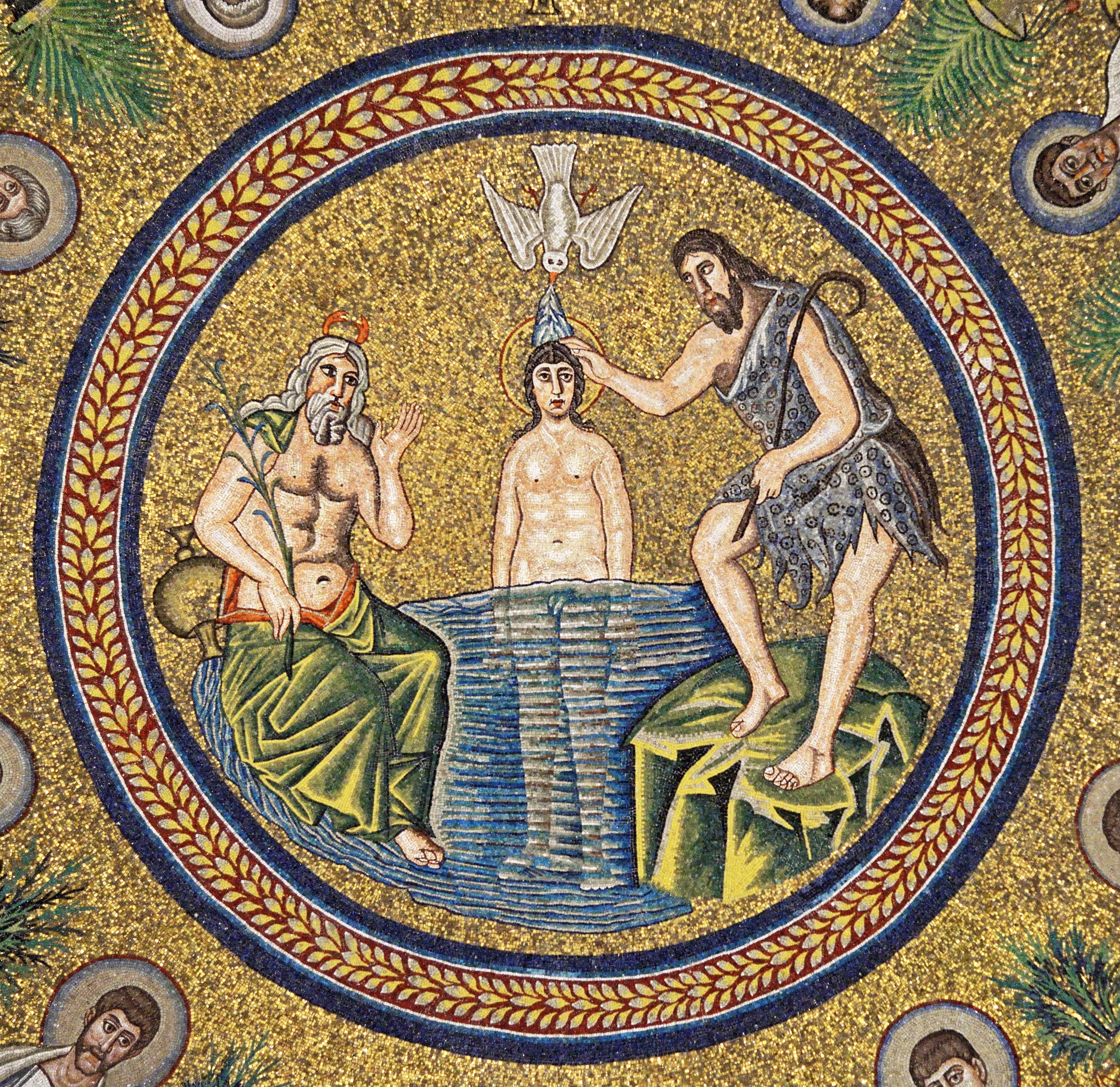
By chance, the missionaries that had converted the Goths had done so before Nicaea, during an upswing in Arianism’s popularity, and so the Goths had become and remained Arians, as the Empire embraced the Nicaean proposition, and became Orthodox. As time went on, the empire crumbled, and the Goths came to military and political prominence, but the religious divide remained. We have, as far as I know, no reliable sources for the practical exercise of Arian Christianity; no liturgies, no calendars, no clearly differentiated church architecture. So we cannot know how different in practice the two creeds were. We have to assume that two or three hundred years of development would mean enough divergence for the two to be obviously different by the time of Liuvigild in Hispania, but maybe not. Maybe it was as subtle as the Guelphs and Ghibiline’s supposedly different ways of cutting fruit. Tribal animosity has rested on less in human history.
Everywhere the Goths came to political prominence, the religion question lurked in the background. Many historians suggest that, in spite of the vitriol of the Orthodox chroniclers, it was actually the Arian Goths who were more firmly devoted to their way of doing things, while the orthodox could be a bit more flexible in pursuit of advantage. Arianism was one of the cultural markers that separated them, the rulers, from the ruled. Remember that it was the insufficiently Gothic upbringing of her son that prompted the rebellion of the Ostrogoths against Amalasuintha, it’s not at all difficult to imagine that there was a religious aspect to that conflict.
In Hispania, the problem was made manifest in every major city, in the question of bishops. We talked last time about the increasing importance of municipal loyalties, and simultaneously, the growth of the power of the local bishops. Well, every city, in theory, had two bishops. The orthodox bishop, with spiritual authority over the majority of the population – and thus a power base; and the Arian bishop, with direct access to the king and aristocracy – and thus a power base. These kinds of tensions could easily get out of hand, and it was a source of instability in Liuvigild’s kingdom that he needed to resolve, now that the external threats had been pushed down into quiescence. It was time to try and bridge the gap.
Now, there has been a lot of research on the early Visigothic period in the last 25 years, but for some reason that has not been enough time for the conclusions of that research to filter its way into the general surveys of the period. Which is to say that what you read on Wikipedia, in this case, is probably out of date. It’s also a lot of words for me to work my way around to admitting that the divisions between Arian and Orthodox may not have been as stark as the chroniclers lead us to believe. Intermarriage was probably becoming more common. Last time I mentioned that Liuvigild reformed the Laws, legalizing marriage between Goths and native inhabitants, and thus as often as not, between different creeds. I tend to believe that this was both a conscious effort to unify his elite subjects, as well as an acknowledgement of a trend that had been on the upswing for a while anyway.
Though I tend to speak of king and nobility as a single bloc, the relationship between central royal power and local noble power was always contentious. Wealth and influence was important in that struggle, and as the opportunities for pillage began to wane, marriage into the old wealthy families would begin to beckon. The pressures of competition amongst elite Gothic families were another ever present driver in the search for wealth and status..Likewise, closeness to the military power of the Goths and access to royal influence would have driven the Old Hispano Roman families to seek out connections. In spite of the vehemence of their respective bishops, slightly spattered with saliva and denouncing their episcopal rivals, status and wealth still counted for a lot. Conversions usually accompanied marriages, and it’s likely that on balance, the process meant more Arians converting to Orthodoxy than vice versa.
In 580, Liuvigild attempted to make the Arian faith more attractive, both to its lapsed children and to new converts. He convened a synod of all the Arian bishops to discuss reforms. They met in Toledo, now firmly associated with royal power. The final declarations of the synod do not survive, and so we’re forced, once again, to rely on the reporting of hostile Orthodox commentators. John of Biclaro reports that the synod declared that should a person convert from Orthodoxy to Arianism, communion from an Arian priest was all that was necessary, no new baptism would be required. This was a kind of lowering of the entrance fee, and implied that the two churches were not as different as the Orthodox clergy presented them. John, who was Orthodox clergy, declares this to be a deception, a kind of bait-and-switch. “Come on over, it’s not really so different after all, and you’ll be in the king’s favor if you do! That’s it, come on in… Ha ha fooled you idiot, welcome to hell!” I exaggerate, of course.
There’s the suggestion that some softening of the Arian view of the trinity was also included in the program, for the more theologically minded. John of Biclaro suggests that the changes enticed many to turn away from the Orthodox Church, but given the way things turned out, it couldn’t have exactly been a flood. The preponderance of evidence that this softening of the Arian line ultimately only eroded the intellectual appeal of Arianism. If it was so similar, why are we even bothering with it? With all of that as background then, we come to the question of the rebellious prince.
This is the point in the show where I’m afraid I need to introduce some family relationships into our story. Often hard to keep track of, especially in an audio medium. You already know about Liuvigild’s two sons, Hermenegild and Reccared. Both had been given responsibilities as they’d grown up, and were clearly being groomed to take over when Liuvigild kicked the proverbial bucket. They were the sons of Liuvigild’s first wife, a woman named Theodosia, but she had died sometime before 570. Liuvigild re-married, as widowed men often do, and for his new wife he made a royal choice: the wife of his predecessor, Athanagild, whose name was Goiswintha.
It was the kind of legitimizing move we’ve seen in the past, as a new ruler tries to connect himself to the previous dynasty. In addition to the symbolism, Goiswintha would have had connections and kin relationships among the other Visigothic noble families that would bolster Liuvigild’s own. We often fail to recognize this when discussing political marriages, it’s rarely mentioned in primary sources, but none of these people were living in bubbles, including the women. I seem to be wandering all over the place today, my apologies.
Goiswintha had two daughters by Athanagild, both married to Frankish kings. Her daughter Brunhild was married to Sigebert of Austrasia, that is the northern and eastern parts of the Frankish realms. Brunhild and Sigebert also had two daughters, though we’re only going to talk about one of them today, Ingund, who was married to Hermenegild.
So to review the relevant names, because I know that made my eyes cross: Liuvigild is the king. He has two sons, the Princes Reccared and Hermenegild. The king’s wife and the princes’ stepmother is Goiswintha. Lastly, Hermenegild is married to Ingund, who happens to be his stepmother’s granddaughter, and who was raised in a Frankish court. Got it?
Here’s the story, as it appears in the sources.
Ingund was an Orthodox Christian, as were all the Frankish royals, so there was bound to be trouble when she arrived in Toledo in 578 or 579 to meet hubby to be. Goiswintha treated her warmly, but insisted that Ingund be rebaptized as an Arian. You’ll note that this is happening one year before the council of Arian bishops changed the requirements for conversion. Ingund didn’t want to be rebaptized, it would put her soul in danger. Goiswintha insisted, Ingund, all of twelve years old, stood firm. According to Gregory of Tours, Goiswintha lost her temper and beat Ingund savagely, pushing her to the ground and kicking her repeatedly, then having her thrown into the baptismal pool.
Shortly after that nastiness, Liuvigild sent Hermenegild to Seville, to act as his viceroy in the south, and build up some experience in preparation for becoming king. Ingund, obviously, went with him, no doubt grateful to escape from her step-mother-in-law/grandmother. While in Seville, the pair met Leander, the city’s Orthodox bishop, and were impressed by him. Leander had a younger brother named Isidore, by the way, and who later would succeed his brother as bishop, and do a bit of writing.
Leander and Ingund quickly began collaboration on a project; the conversion of Hermenegild to Orthodoxy. Under the influence of these two, Hermenegild did indeed declare his rejection of Arianism, and declared himself in rebellion against his father. It’s hard to say for sure, but it seems that Leander and Ingund had done their work quickly, and that this declaration of conversion happened shortly after Hermenegild arrived in Seville, in 579. Liuvigild probably considered this treason, but he was nonetheless in the midst of his church reforms, so at first there seems to have been little violence, and the whole thing was more of a feud between father and son. And indeed, when violence came it seems to have been Hermenegild who initiated it. In 583 or 4 he raised Baetica in revolt and went looking for support from the neighbors, using the religious differences as a justification for his rebellion.
He found support from the Suevian king Miro, who mustered an army to march south in support of the rebellion. Liuvigild responded, laying siege to Seville, and fighting a battle against the Suevi, in which Miro was killed. The siege of Seville lasted for months, but eventually the city fell, and Hermenegild and his family fled to Cordoba. There they were met by a small contingent of men sent up from the Byzantine lands, but Liuvigild bribed them, and they withdrew. Hermenegild was able to send his young wife and daughter with them into safety though. Interestingly, no support was forthcoming from Ingund’s Frankish kinsmen. There seems to have been little sympathy for Hermenegild there.
When Seville Hermenegild fled to the church and Liuvigild was not foolish enough to pursue him. Instead, he sent his brother Reccared inside to try and find some kind of peaceful resolution. The two brothers were able to come to an agreement. Hermenegild may have returned to his father’s palace in Toledo, the stories are not clear, but there was peace for a while.
Hermenegild still maintained his Catholicism, and this apparently irritated his stepmother. Goiswintha worked on Liuvigild to force his son back to the creed of his fathers, but Hermenegild refused to be forced. Eventually the split within the family worsened again, and Hermenegild was imprisoned. There would be no happy reconciliation this time, Hermenegild was killed in prison on his father’s orders on 13 April 585. Afterwards, as the murdered prince waited for burial, the song of invisible singers could be heard near his body, and after he was taken away, strange lights were seen in the place where he was laid. Thus he was declared a martyr to the Catholic faith, and revered as a saint not long afterward.
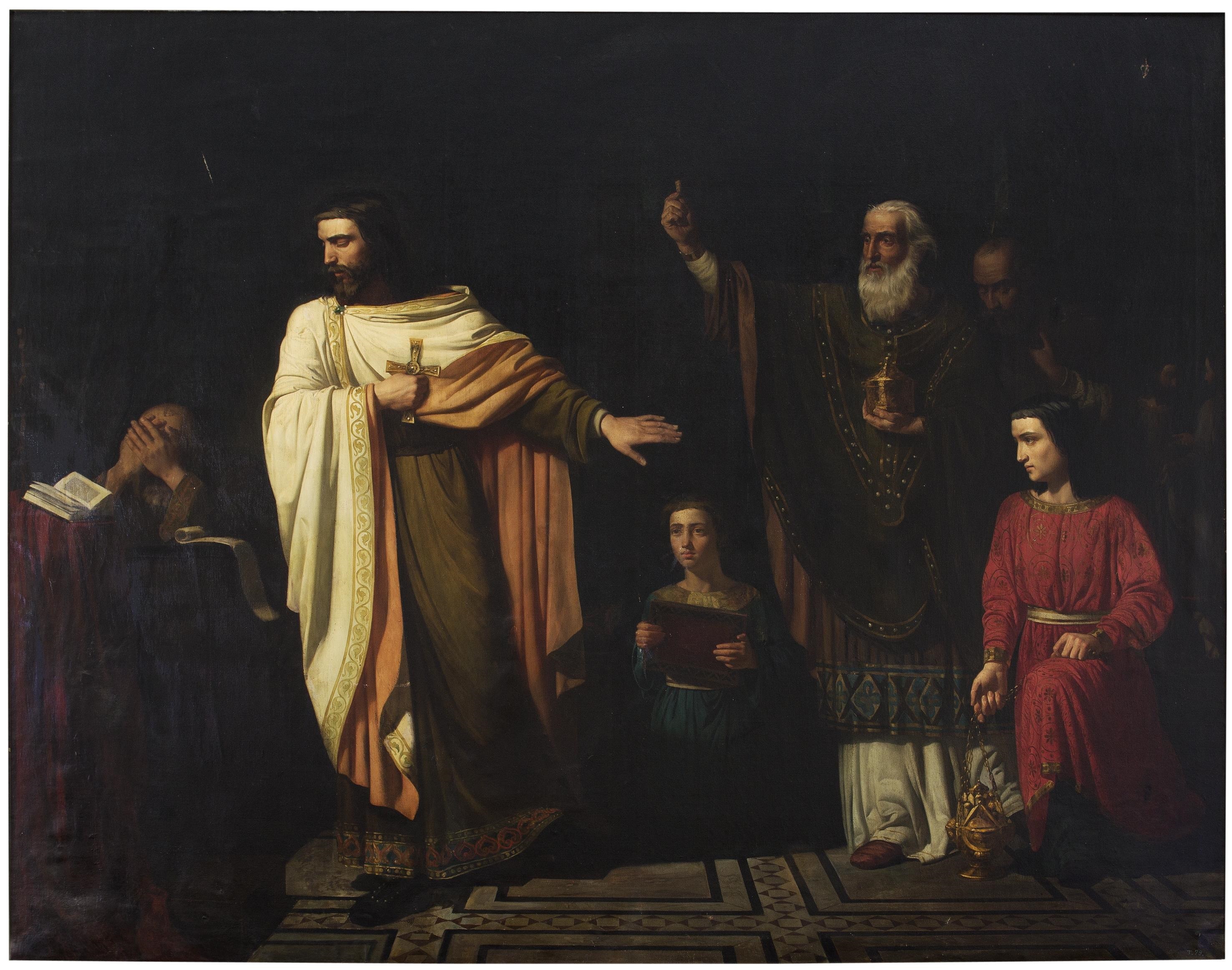
Hermenegild rejects the admonitions of an Arian priest in prison. According to Pope Gregory, this is the event that precipitated his execution. This painting is by Francisco Aznar, from about 1860, and is from the collection of the Museo del Prado in Madrid, though it is actually displayed at the University Central of Barcelona. 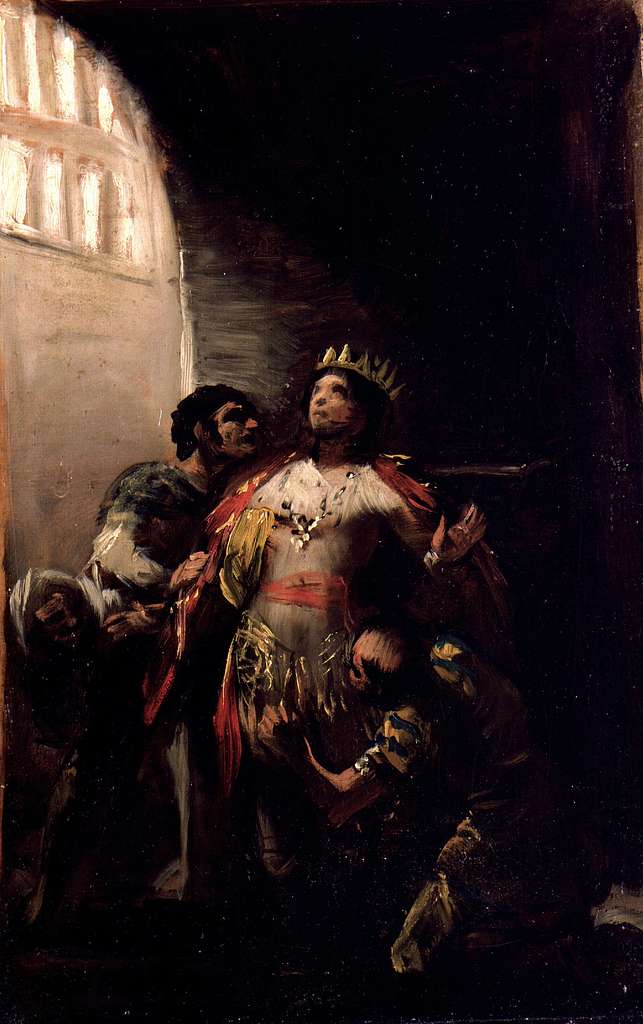
Goya also produced a version of the scene in 1799. This painting today is the Lazaro Galdiano Museum in Madrid.
So that’s more or less the story, as distilled from a few sources. The story appears in Gregory of Tours’ histories, as well as John of Biclaro’s chronicle, and briefly in Isidore of Seville. The most influential version of the story though, appears in the Dialogues of Pope Gregory I, written about 593.
Only in Gregory’s account is Hermenegild presented as a martyr for his faith. Isidore barely mentions the rebellion. John, who is probably closest to the events, does not mention religion at all as a factor in Hermenegild’s rebellion, nor does he explicitly blame Liuvigild for his son’s death. He merely relates that “Hermenegild was killed by Sisibert in the city of Tarraco.” Who Sisibert was, whether an official executioner or hired thug (if there is a difference), is unknown.
Gregory of Tours does indicate that religion drove Hermenegild’s rebellion, but even he does not go so far as to call Hermenegild a martyr or paint him as a hero. Even to the fanatically anti-Arian Gregory, a son’s disloyalty to his father was too great a sin to make the prince a heroic figure. So it was left to the papal Gregory to lionize Hermenegild, crediting him with paving the way for the conversion of the Visigoths in the coming reign of his brother Reccared. Because that’s where this is all heading. Gregory pointed to John 12:24 as the relevant text: “unless a grain of wheat falls into the ground and dies, it remains alone. But if it dies, it produces a lot of grain.”
Hermenegild remained on the roll of martyrs through the middle ages, his prominence helped by Gregory, but never in the first rank of saints, until the reconquista began to gather steam in the 13th and 14th century. Once the reconquest of Hispania was complete, interest grew in the “golden age” of the Visigoths that had existed before the Moorish invasion, and Hermenegild’s popularity peaked in the seventeenth century. He still gives his name to the Royal and Military order of Saint Hermenegild, an award and military legion which remains the highest decoration for the Spanish Military to this day.

The absence of the religious angle from the closest observers makes the question worth asking: what was really going on here? It’s possible that Hermenegild was indeed influenced by the orthodox bishop Leander, and rejected his father’s Arianism. It’s possible that such a course would have been irritating to Liuvigild, given that he was actively attempting to make Arianism more acceptable to the populace as a whole. It’s hard to date Hermenegild’s rebellion specifically, but the fall of Seville came either in 583 or 584, after a siege that lasted months. Coming so quickly after Liuvigild’s church council in 580, it would make sense for the king to be a bit touchy about religious issues at the time. But I’m not sure, frankly, that it’s enough. It seems deeply counterproductive to brutally pursue and murder an apostate son at the same time as one is trying to sell the benefits of conversion to a reluctant populace, and Liuvigild strikes me as a canny old bird. The charges of persecution the chroniclers level against him are never very specific, and feel a little rote. So I’m inclined to agree with Michael Collins, my guiding light in all things Visigothic, that there’s more going on here than just a religious spat.
Especially notable, to me, is the intervention of outside powers. Both the Suevi and Byzantines make their appearance in the story. Both most likely came hoping to exploit divisions in the Visigothic state, and both found that it was too late for that. The death of King Miro outside Seville sent the Suevic kingdom into yet another spasm of internal conflict that ended half a decade later when Liuvigild casually invaded in 585 and forced them to submit to his direct rule. The death of the kingdom of the Suevi seems almost incidental to the rebellion of Hermenegild, and their integration into the Visigoths’ Hispania was apparently swift and complete. Though many have tried, no clearly identifiable cultural traits have survived to the present day; whatever remained seems to have been swept away by the Muslim invasions of the eighth century. So farewell, Suevi, we hardly knew thee.
The appearance of the Byzantines is actually more puzzling than it appears at first glance. In all the Byzantine interventions we’ve seen, support for an anointed ruler has been the excuse, the thin edge of the wedge. We’ve seen it in Africa, in Italy, and most recently even in Hispania, if our interpretation of Liberius’ expedition is correct. So it would seem out of character for the Byzantines to come to the aid of a rebel, even a co-religionist. It may be that this is opportunism, which would also explain how Liuvigild was able to deal with them so easily, by bribery. It may have been more Byzantine, though, if you’ll forgive the pun. With Hermenegild sent by his father to the south to run things, the Byzantines may have made contact with him and incited the rebellion. Hermenegild was young and may have had his head turned by promises of support and increased power for himself.
There’s also the suggestion that Ingund, Hermenegild’s wife, may have had more political influence than appears at first. She might have been whispering in her husband’s ear that he should really have more independence from his father. Who knows, maybe she was a channel for Byzantine influence. We shouldn’t fall into the medieval misogynist trap of assigning blame for all evil scheming to women, but neither should we go too far in the other direction and assume that noble women were powerless or without agency. Ingund had reason to be resentful at the way she had been treated at Liuvigild’s court; it’s possible she may have put ideas into Hermenegild’s head.
Absolutely all of that is speculation, and the truth is probably unknowable. Normally I try not to be too cynical about these things, but in this case, I tend to believe that Hermenegild’s rebellion was motivated more by a misguided search for personal power than by religious feeling. Likewise, my guess is that Hermenegild was successful enough in attracting support, both of outside powers and probably of Visigothic nobles looking for a bit more independence, that he ultimately could not be left alive. An apostate prince could maybe be isolated and reasoned with, a political threat and leader had to be dealt with, and so Hermenegild’s execution in prison – not in public, note – became a necessary evil.
It would not surprise me one little bit if there were religious differences between father and son, which was enough of a peg for Pope Gregory to hang a martyr’s hat on a decade later. Gregory was a masterful writer and advocate of the faith, who probably deserves his own episode, and he was canny enough to recognize a useful story he could spin for his own purpose.
In the long run, the ultimate beneficiary of Hermenegild’s rebellion was his younger brother, Reccared, who now had a clear path to the throne. He didn’t have long to wait.
On April 21, 586, Liuvigild died in his bed, in Toledo. He had been sole king of the Visigoths for fourteen years. Under his leadership, Hispania had been united under a single ruler, and central royal authority had been established. Only the Byzantine province remained apart. His was the authority of violence, and unity by conquest, but there probably was no other way it could have been achieved.
His son, Reccared, was acclaimed king immediately and without rancor by the Visigothic nobility. Whatever divisions had existed thanks to Hermenegild’s disloyalty were forgotten. In the light of such clear support, Reccared made a decision that would be the final stone in the foundation his father had laid for a true successor to the Roman Empire: he declared his acceptance of the Orthodox faith, and rejected Arianism. It was the watershed moment in the history of Visigothic Spain, and we will talk more about it next time.
 The Dark Ages Podcast