586 to 601 CE
Reccared takes the throne and makes a momentous change. The Visigothic kingdom becomes unified under one religion and climbs to a new level of stability and security.

Hello and welcome to the Dark Ages Podcast, episode 53: Of Outstanding Goodness.
Before we get started, I have a couple of corrections and a clarification from last time.
First of all, I gave a shout-out to my constant companion in Visigothic studies, Michael Collins. The thing is, Michael Collins was an Irish revolutionary, and whatever else he accomplished, he contributed very little to early medieval scholarship. Roger Collins, on the other hand, is an honorary fellow at the University of Edinburgh and is a prolific writer with an academic CV as long as my arm. So my apologies for that.
Second, I said last time that the Suevi were Arians, so their support for Hermenegild was purely politically motivated. I still stand by the idea that King Miro came to Hermenegild’s aid primarily to weaken Liuvigild, but I was wrong about the Arianism. The story of the Suevi’s conversion to Catholic Christianity is utterly impossible to pin down, at least four versions exist, all mutually exclusive, but there is no question that by 580, the Suevi were Catholic. Mea culpa.
Lastly, I want to address a comment made on Spotify, in response to episode 51, the Liuvigild episode. This was from a user called BlindCavefish, which makes the comment all the more impressive. It’s not massively long, so I’ll just read the whole thing: “If we’re going to make a division between Roman and Byzantine I think it would be the century after the Arab conquest. That’s when you really see the Roman identity shifting from this complex multinational conglomerate to being an almost proto-nation-state of Orthodox, largely Greek speaking people.”
That was in response to me marking the death of Justinian in 565 as the transition date between the Roman empire and Byzantine empire. To start off, the question is purely academic, since absolutely no one at the time would have called the imperials Byzantines. The term appeared in the 15th century, and existed alongside several others until it came to prominence in the 19th century. The transition from Roman to Byzantine did not exist as a distinct event, its entirely retrospective, just like any other periodization.
More directly to cavefish’s point, I think it’s absolutely valid. The Arab Muslim invasions were an enormous disruption of the status quo across the Mediterranean world and beyond. And it’s one which frankly terrifies me as it draws ever nearer in my viewfinder. The idea that it started a shift in worldview within the eastern empire is absolutely true, with all kinds of consequences. I chose the death of Justinian because it marked the end of any serious expansionist efforts in the Western Med, and for the language shift that began at around that time, away from Latin and toward Greek. I have one other motivator, and that’s a narrative one. The sooner I could stop referring to Romans while simultaneously referring to Hispano-Romans or Gallo-Romans or whomever, the better. So more than anything, the distinction rises from a need for clarity rather than any deep analysis of the situation in the Eastern Empire. By the way, if you want to know more about said empire, it’s been a while since I recommended Robin Pierson’s History of Byzantium podcast, though I kind of assume most of you are already familiar with it, it’s been around for quite a long while and is still going strong.
Okay, in this episode we welcome Reccared to the throne. Recarred represents a major break in the history of Visigothic Hispania, since he was the king that finally abandoned Arian Christianity in favor of Catholicism. By that conversion, he began the process of integration between the Hispno-Roman landowning elite and the Visigothic military elite, to form what our old friend Herwig Wolfram described as “the most complete successor state to the Roman Empire, a perfect replica in its strengths and weaknesses.” I’m going to talk today about Reccared and the Visigoths’ conversion, and its immediate consequences.
Liuvigild’s Achievements
First though, I feel that I’ve done Liuvigild a disservice, and not really explained exactly how he brought Hispania to a point where Wolfram could make that declaration, so if you will allow me, I’ first going to take just a few minutes to pull the old man out of his tomb, brush him off a bit, he’s not looking great, and talk just a little bit more about his achievements. Achievements that his son would very much benefit from.
Liuvigild, more than any other Visigothic ruler since the disaster at Vouille, worked to create and emphasize continuity between his own rule and the imperial past. The Visigoths were as thoroughly romanized as any Germanic group could be, they understood the benefits of the imperial system and were absolutely capable of imitating it. They were prevented by circumstances from fully doing so through the first half of the sixth century, but Liuvigild managed to find the stability needed to tackle that project..
Liuvigild struck currency at Reccopolis and Toledo and elsewhere, the only truly broadcast media at the time, and on his coinage presented himself in raiments directly modeled on Roman and Byzantine coinage. He most likely added Flavius to his list of regnal names, as most of his successors did, a mark of legitimacy and continuity back to Constantine the Great. Byzantine, Ostrogoth, and Lombard rulers would do the same. I’ve used the metaphorical phrase “ascended to the throne” all willy-nilly throughout this podcast, but for Liuvigild it was literally true. Isidore of Seville noted that “he was the first to sit upon a throne among his own people, covered as he was in regal clothing. For before him, the habit of sitting together was something in common for the people and kings.” If we take Isidore at his word, then Liuvigild was making the point that as king he was something apart. He was not just a warlord, not first among equals. Kingship made him special, and it made his family special.
Since the failure of the Balts, the central principle of Visigothic succession had been “devil take the hindmost”, and decades of murderous civil war had been the result. When he raised his sons, Hermenegild and Reccared, to the status of co-rulers, he was signaling to his nobility that there would be none of that nonsense when Liuvigild went to meet his maker. That nobility was prepared to accept that message because Liuvigild had spent at least as much time stomping on their necks as he had on the necks of the Suevi, Basques, or Byzantines. Isidore describes the process as “pernicious to some of his own people, for whomever he saw as most noble and powerful, he either decapitated, or proscribed them after taking away their wealth, and after proscribing them he sent them into exile. [He was] the first to enrich his private treasury, and the first to increase the public treasury through the plunder taken from citizens and enemies.” Isidore frames this as tyranny, and it probably was, but it also was a process of making the king the richest and most powerful noble in the realm, and able to smush any and all noble unrest.
By making himself supreme, Liuvigild removed the nobility’s ability to mount effective rebellion, and so ensured his own security, and the security of his son.
Okay, that made me feel better. We can return Liuvigild to the grave to rest, and move on to Reccared.
The New King
Reccared was acclaimed king in 586, probably in Toledo. Thanks to his father’s groundwork, there was no hurly-burly from the nobility, and he took the throne with “tranquility” in the words of John of Biclaro. Shortly afterward he announced his conversion from Arianism to Catholicism, and John and Isidore are both enthusiastic in their praise. According to Isidore of Seville, Reccared was “pious in faith and outstanding in peace”, and John recounts a successful king, beloved of God and the recipient of His favor. It’s a turnaround from the previous kings who, no matter how successful they were in battle or whatever, always bore the stain of heresy, as far as our Catholic commentators were concerned. Ten months after he came to power, Reccared announced that he would convert to the Catholic creed, and expected his people to follow him – and now our historians can praise a king enthusiastically and without qualification, and their relief is visible on the pages.
The story of Reccared’s reign is a curious challenge for a teller of historical tales. It is one of the best recorded of the Visigothic regna, but only for the first half. Alas, despite his importance socially and religiously, John’s Chronicle ends abruptly in 591, just four years into Reccared’s 15 year reign. Isidore carries through to his death, but the last dateable event he mentions before that is in 587 or 8, even earlier than John (and Isidore as a rule is never a particularly specific writer). That means we’re left with sources from outside Hispania to piece together the remains of Reccared’s time in power. Gregory of Tours mentions him occasionally, though as always his interest in Hispania is tangential at best, and he died in 594. Other than that we’re stuck with the Chronicle of Fredegar, which I’ve mentioned before, and which has to be used with extreme caution. Fortunately for me, there’s more than enough in those first years to fill out a podcast episode. Obviously there’s the conversion, and a couple of rebellions related to the conversion. Then there’s that statement by Wolfram that the Visigothic kingdom became the most complete successor to the Roman empire, which we’ll dig into a bit as well.

Conversion
To begin with, conversion. We’ve seen the conversion of a Germanic ruler before, when Clovis the Frank converted to Catholicism, and brought his people with him. That was a conversion from paganism though. While turning away from centuries of tradition and the ancient worldview of his people couldn’t have been entirely easy, there were no institutional blockages in the way of Clovis’ decision. We don’t have a super firm understanding of Germanic paganism in the fifth century, but it’s pretty obvious there was not a large bureaucracy or institutional structure in place to ensure uniformity and protect its own power. Converting from Arianism meant disenfranchising an established corporate entity. Arian bishops were no less organized, invested, or connected than their Catholic counterparts.
And yet, Reccared’s announcement, ten months into his reign, was not met with screaming protest. It did not trigger civil war. We know that it could have, look at what happened to the Vandals, as their kings moved too quickly one way or the other and triggered internal violence, which ultimately attracted outside intervention and the end of their dominion in North Africa.
Reccared’s success was probably due to two things. First, it’s likely that Arianism was already struggling, and there were no powerful forces to undertake civil war, or two, that Reccared spent those ten months doing what every lawyer and businessman knows is crucial. He was lining up support before he presented his proposal to the board. Never make a suggestion unless you already know the answer’s going to be yes. As I say, it was probably a little of column A and a lot of column B.
There would have been a lot of pre-negotiation that went on. Bishops of both communities existed in many if not most of the major cities, each with their own networks of influence and authority. The Arian establishment was the primary channel through which the king communicated to the people, while the spiritual health of most was looked after by the Catholic establishment.
The kind of conflicts that existed between these prelates can be glimpsed in a work called the Vitas Patrum Emeretensium, The Lives of the Fathers of Mérida, which records the activities of that city’s bishops in the second half of the sixth century. From this, we know that the Catholic Bishop of Mérida was a Goth named Masona. His Arian opposite number was named Sunna. It seems likely that Masona had greater authority over the lay population of the city, but Sunna had greater access to the king, Liuvigild in this case. Sunna demanded that Masona turn over a relic of Mérida’s most important Saint, Eulalia. Masona refused, of course. But Sunna appealed to the king, who forced Masona to part with the relic. Being forced to attend the Arian church in order to access the intercession of the Saint gave the Arians power that significantly counterbalanced the Catholics’ numerical advantage. Shortly thereafter Masona was deposed by Liuvigild and replaced by another Catholic bishop who was willing to be a bit more cooperative.
The issues of access and influence were the most important stumbling block to achieving the religious unity that was clearly needed. Specifically, the Gothic lay nobility would need to be brought on-side. If the nobility, the leaders of the military arm of the state, maintained their support for the Arian clergy, then Reccared’s conversion scheme would have failed. A long while ago, in the general episode on war, I noted that the power imbalance between the military and civilians was vast. Even with their much greater numbers, the Catholic bishops and laity would be no match for the Visigothic military elite and their contingents. Both the Arian clergy and the Visigothic nobility would have to be convinced that they would maintain their status after the Arian church was disestablished and the lines of royal communication switched over to the Catholic networks.
Alas, the dark age remains dark for us here. The nature of the negotiations that took place before and after Reccared’s conversion are hidden, but they must have been long, complex, and difficult. They must have continued after the king’s announcement of his decision as well as before. What we can work out is that the extant Arian clergy were not all tossed out on their ears, Arian priests would share their resources and functions with their Catholic counterparts, and the church would die by attrition, as Arian bishops were not replaced as they died. The metropolitans of the Arian church, who had province-wide authority, could not be allowed to continue, they were far too powerful, and so all of them were deposed. The complexity of ruling a kingdom, rather than just a wandering tribe, is evident here, Alaric the first never had to deal with this kind of thing while he was leading his Visigoths up and down the length of Italy. Ah, happy days.
The Council of Toledo
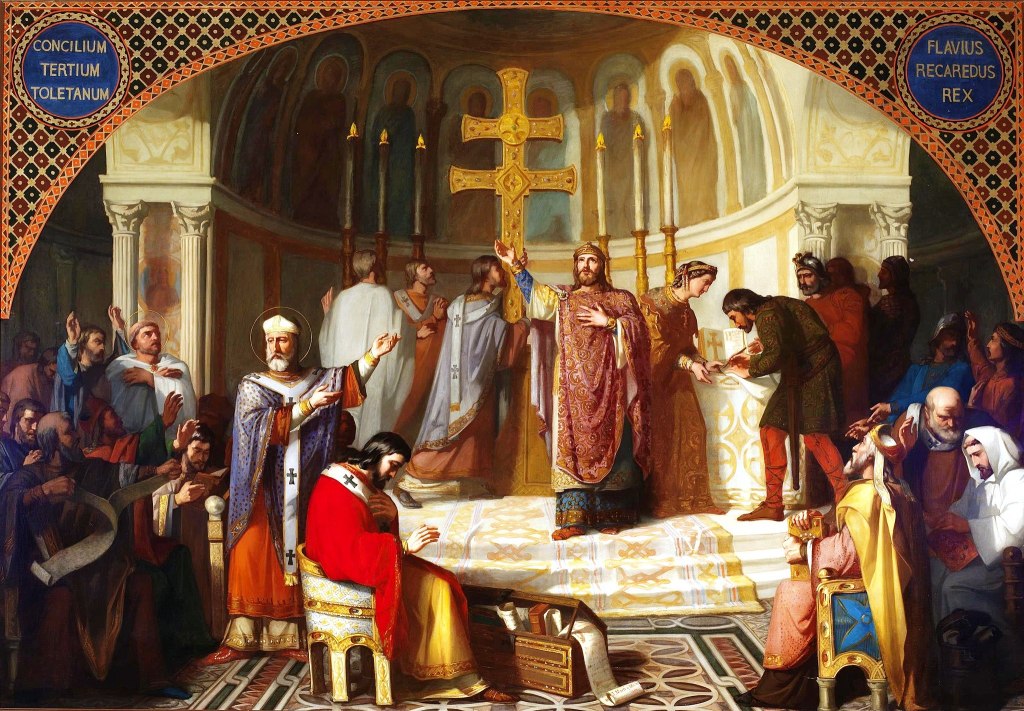
A little less than two years after Reccared’s conversion, he called a convocation of the Catholic bishops of Hispania and Septimania (I always leave Septimania out for some reason, but here’s your reminder that the Visigothic kingdom extended up along the coast almost all the way to the mouth of the Rhone). They met in Toledo in what was probably the largest gathering of leaders in the region since the withdrawal of the Empire. The whole thing was presided over by the king and his recently wed queen, a woman named Baddo.
Brief digression alert. Baddo is a little bit of a mystery; its not clear who she was or where she came from. Even the date of her marriage to Reccared is unknown. It could not have been before 584, since Reccared had been betrothed to a Frankish princess, until the death of her father scotched the idea. She has a Germanic name, and it’s likely that she was of Visigothic noble birth, and the two may have been married shortly after Reccared became king. But there are two things about her that make the mystery really interesting. Baddo is the only Visigothic queen who is known to have signed official documents, both church and secular, and so seems to have wielded an unusual amount of influence for a woman in the Visigothic kingdom. Second, more amusing than historically relevant, are the two genealogies, produced in Zaragoza in the 13th century, that name Baddo as the daughter of King Arthur, and so tie the Visigothic kingdom into the Matter of Britain. I find that interesting mainly because it speaks of the popularity of Arthuriana in Iberia, which you never hear about most of the time, the space being dominated by French, German, and obviously English sources. There is basically no chance of it being true, like all parts of the Arthur legend, but once I found it I had to mention it.
Back to the knitting.
The Council of Toledo was organized enthusiastically by bishop Leander of Seville, who had been forced into exile following Hermenegild’s rebellion and now returned in triumph. 72 bishops attended, along with an uncounted number of lesser clergy and lay nobility. Among those 72 were 8 Arian bishops, who Leander and the king had persuaded to attend.
Reccared participated in the deliberations of the council, and by doing so took on an imperial role. In the East, the Emperor was the head of the church, and with the patriarch of Constantinople made decisions of dogma and canon law. It had been so since the time of Constantine. Now Reccared took on that piece of the imperial aura, and so moved another step away from tribal war leader toward magisterial king. He presented his confession, probably written for him by Leander, to open the synod, which was his final statement of conversion. The creed of Arius was anathematized, and twenty three canons, or edicts, were produced. I’m not going to go over all of them, but there are two that deserve special attention.
Canon 14 prevented Jews from marrying Christians or keeping Christian slaves or concubines. It also barred them from any occupation that would give them authority over Christians, so all but the most menial.
Filioque
Most significantly for the future, Canon two decreed that at communion, the creed of Constantinople would be recited, with the controversial filioque clause included. “The heck is a filioque?” is your question, which I shall answer in another digression.
The Creed of Constantinople was a modified version of the Creed of Nicaea, and was a complete statement of all the core principles of faith for Catholic believers. It defined orthodoxy. The text is widely available online and is a lot shorter than one might expect, given its importance, only 164 words in Latin, 224 in the current English version (in the Catholic liturgy, to be specific). The filioque controversy is another one of those controversies that sounds extremely esoteric to most of us today. Once again, the nature of the trinity is at the center, this time the source of the Holy Spirit. The creed arrived at at Constantinople includes the lines
Et in Spíritum Sanctum, Dóminum et vivificántem:
qui ex Patre procédit.
“And the holy spirit, the Lord and giver of life, who proceeds from the Father, and who with the Father and the Son is adored and glorified.”
The version adopted at the Council of Toledo reads thus:
Et in Spíritum Sanctum, Dóminum et vivificántem:
qui ex Patre filioque procédit.
“And the holy spirit, the Lord and giver of life, who proceeds from the Father and the Son, and who with the Father and the Son is adored and glorified.”
That one word, filioque, made its first appearance in the West here, at the Council of Toledo of 589. It would become one of many sources of friction between the eastern and western Churches. All of that though, was as a small cloud on the horizon, no bigger than a man’s hand.
The restrictions placed on Jews led to a wave of conversions for some, emigration for others. Communities of exiles settled in Ceuta and other cities in North Africa, which were technically under Visigothic rule, but out from under the eyes of the bishops. They would remain there until the Arab invasions of the next century, in which they would play their part.
The council ended with a homily delivered by Leander in triumphant terms on the victory of the true Catholic Church. I imagine he struggled to avoid sounding too smug. The first bishop to sign the final Acts of the Council was Masona of Mérida, returned to his diocese and probably also feeling pretty good about things.
Rebellions
The negotiations that preceded the council, no matter how careful and sensitively done, inevitably resulted in winners and losers. No compromise can please all parties, and the Jewish exiles were not the only discontented parties.
In addition to those disenfranchised metropolitans I mentioned before, the hardline Arian nobility could and did expect a loss of influence, since they had no connection to the Catholic networks. Not to mention that Reccared immediately began using royal resources to undertake building projects on behalf of the Church. Even more worrying, he began to take steps to return property seized by Liuvigild to their previous owners, some of which probably had made its way into the hands of the Arian nobility in the meantime. For these, facing the loss of wealth, status, and influence, violence became the only available option.
The first disturbance was actually before the council, in 587 and arose in the west. A noble named Segga conspired with others to seize the throne from Reccared. He was supported by Sunna, the Arian metropolitan of Lusitania. The plot involved several other nobles, and their hit list included Masona and Claudius, the powerful Hispano-Roman dux of Lusitania. One of the conspirators confessed to the king, and the plot was foiled. The squealer was named Witteric, and he would eventually become king himself.
Compared to the horrors of later centuries, Segga and Sunna’s punishment was relatively lenient. Segga was separated from his hands and exiled to Galicia – the hand thing would be unpleasant, but Galicia has excellent seafood so there were compensations. Sunna meanwhile was exiled to North Africa, which again, could be worse. He was eventually martyred there for proselytizing Arianism, but that’s hardly Reccared’s fault.
The next challenge to the new order struck closer to home. Reccared’s stepmother, Goiswintha, who we met last time, had bowed to her king’s wishes, and converted. She did so with her fingers crossed behind her back, because the next time we hear of her, she was “laying traps” for Reccared, along with another Arian bishop named Uldila. We have even fewer details about this conspiracy; all John of Biclaro tells us is that Uldila was exiled, and that Goiswintha “came to the end of her life”. As far as ambiguous sentences go, that’s pretty much in the top tier I think – was she executed, commit suicide, die a natural death? Who knows. Historians tend to squint at this one a little bit, it’s so close to the king and so scantily reported, it may be that the conspiracy was trumped up a bit in order to get rid of a rival focus of power close to Reccared, rather than a genuine threat. At this distance though, it’s impossible to know for sure.
Shortly after the failure of Goiswintha’s conspiracy, a different threat appeared, as a Frankish army invaded Septimania. These belonged to Guntram, who ruled in the southeastern part of Gaul and had been trying to add Septimania to his territories – off and on – for years. The army laid siege to the frontier fortress of Carcassonne. Claudius, the commander who had been the target of the earlier conspiracy, commanded the response. John of Biclaro reports that he led 300 men to Carcassonne and defeated the Franks, who numbered 60,000. The numbers would be best used to clean pigs, as they are clearly hogwash, but the point is that it was a significant victory, one of the greatest over the Franks in a long time, and it lent the luster of God’s favor to Reccared and his reign.
We are told of one more plot against the newly Catholic monarch, shortly after the Toledo council. A Gothic duke of Carthaginensis declared himself king, apparently having missed the memo about a stable dynasty that could stifle uppity nobility. The plot seems not to have gone very far, and the duke was captured, whipped, his hair was shorn off, and his right hand – his oath-taking hand – was amputated. At last he was led around Toledo on a donkey, to demonstrate the humiliation in store for those who forgot their loyalty to the king.
The Imperial Heritage
That’s pretty much all we have for Reccared in terms of incident. As I said before, our sources for the latter part of the reign are patchy and unreliable. It is abundantly clear that the Visigothic kingdom was in better shape than it had been for decades. There was at last a partnership between church and civil authority, and the Hispano-Roman population no longer had to split their loyalties between the two. The reconciliation with Orthodoxy also allowed Reccared to claim imperial authority in his lands. By that I mean that he placed himself at the head of not just the civil and lay government, but at the top of the Church structure in his lands as well, just as the emperor did in Constantinople. He declared in a letter to Pope Gregory that he was the highest authority his subjects had, after God. This positioning is probably the biggest contributor to Herwig Wolfram’s assessment of the Visigothic kingdom as the empire’s most complete successor. It also incidentally reminds us that the supremacy of the Bishop of Rome outside Italy was far from established.
There is also evidence for a very Roman sounding bureaucracy that grew up around the king, with many posts being mentioned, even before Liuvigild and Reccared, that derived directly from the old Roman apparatus. For example, the comes notariorum, the chief notary of Toledo, was a direct carry-over from Western Roman practice. It was an active position, not just a sinecure, and the acts of every council that took place in Toledo bore his signature. In spite of the administrative utility of such a position,it wasn’t retained in any of the other West’s other successor kingdoms, and didn’t even exist in Constantinople.
The Visigothic kingdom was divided into civitates, largely reviving the old imperial borders. These were administered by comites, or counts, some of these especially along the frontiers were collected under the control of a military commander who bore the Latin title dux – duke. In the cases where we know the names of these nobles and administrators, they are both Latin and Gothic, though the militarized dukes were more likely to be Gothic. All of this was alongside the church hierarchy, which doubled as the kingdom’s primary channel of communication to the population.
That last rebellion was in 589, and Reccared ruled until 601, when he died peacefully at Toledo. Isidore was not stingy with his praise: Reccared was “pleasant, mild, of outstanding goodness,” and ruled a Hispania that was “preserved in peace, arranged in fairness, and ruled in moderation.”
Given that Isidore’s history is the only contemporary comment, I’m prepared to accept his judgment, faute de mieux, especially since it’s likely that Isidore had first hand interaction with the king, or at least had heard his brother’s assessment of him. Reccared died at the age of around 41, give or take, and the crown passed to his son, Liuva. There was no rancor, the Visigothic kingdom had been made secure, and integration of Visigoth and Roman was well underway, in an organized polity that replicated, as best it could, the old imperial ways.
It would turn out that the ease of succession was pretty much the high point of Liuva II’s reign. But we’ll come back to the Visigothic kingdom at some later date. The fact was that no matter how successful Reccared or his father or their successors were, subduing the Suevi, pressuring the Byzantines, or raiding and counter-raiding the Franks, there was one enemy that they never fully subdued. And indeed, they’re a community that has never been completely subjugated by any state, to this day. Next time, I’m going to talk for one episode about the Basques.
 The Dark Ages Podcast