From Wikimedia Commons.
This one explores a story of one particular Egyptian saint, and the strange case of the woman transformed into a horse. It’s just a bit of anthropological fun.
Surprise! I’m sorry to interrupt the narrative flow, but I came across something, and I felt a strong need to write it up and share it with you all. It involves a nexus of History, Anthropology, superstition, and religion. It also dates from earlier than our usual concern, and comes from an area outside our usual remit, but it was just too dang interesting for me to not share it.
While noodling around in my research, a book called Sexuality in Late Antiquity came to my attention, as well it might. It is an anthology of essays and lectures, very scholarly and non-prurient, edited by Elizabeth A Castelli. (Thanks academia.edu! Still not signing up for the paid plan though!) I skimmed through the various offerings without finding much to catch my attention, until I came to a paper called The Perils of Love: Love and Magic in Coptic Egypt. Well, there I stopped and began to read.
I’ll be honest, it will get a little bit deep in the academic weeds, and may not be for everyone. We will be back to the Gothic Wars and regular scheduling next time, and I will not think less of you if you take this moment to bail on this episode.
The piece is by Dr. David Frankfurter, then of the University of New Hampshire, now at Boston University. Because of the Rocky Horror Picture Show, but mostly because I am a child, I will be referring to him as Dr. F for the remainder of this episode. The paper deals with a story that appears in a couple histories of Early Christian Saints active in the Syrian and Egyptian deserts, collectively known as the Desert Fathers.
The story concerns Saint Macarius of Egypt, and his removal of a curse. It appears in two versions, both dating to the early or middle fifth century, and both were probably current by the end of the fourth century. I’m not sure I’ve mentioned Egypt at all except in passing, so that’s what I mean about going fairly far afield. But the story gives a flavor of the kind of blending of Christian and Pagan practice and superstition that was happening inside the late Roman empire, and would continue to be seen as Christianity spread outside the old Empire’s borders and interfaced with Germanic, Slavic, and other traditions. As might be expected, we are going to touch on sex magic in the course of this (which is just what it likes), and while none of the language is what you’d call explicit per se, we’re still going to be talking about human sexuality. If that isn’t something you want to hear, then here is your second chance to bail.
I’ll start by talking a little bit about Macarius, relate the story, and then we can talk about what it all means. I am obviously going to be drawing heavily on the original paper by David Frankenfurter. I have a book or two on magic and folk beliefs on my shelves but haven’t gotten to them just yet, maybe this will provide the impetus for more investigation.
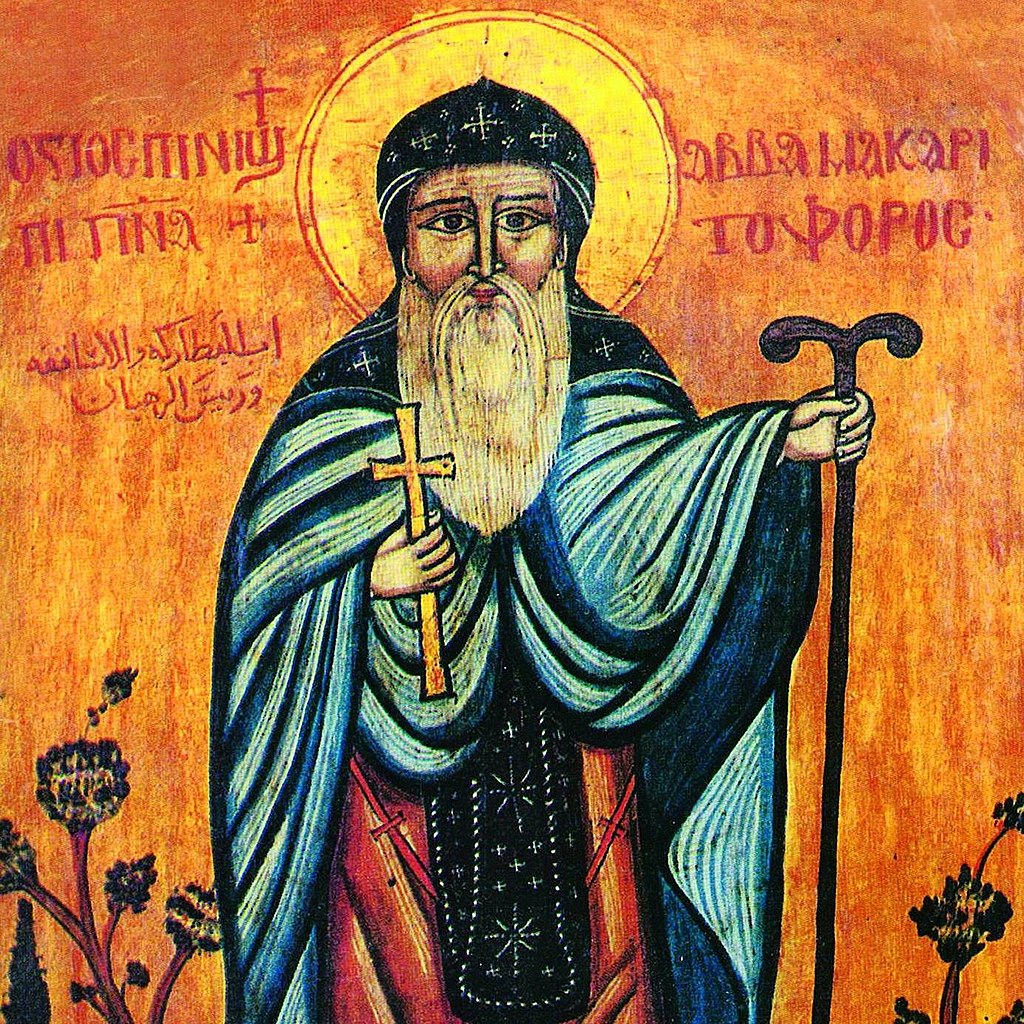
To start with, Saint Macarius was a coptic Christian, which in this context just means he was an Egyptian Christian who spoke coptic, the latest development of the ancient Egyptian language. Coptic was heavily influenced by Greek, thanks to the Ptolemaic dynasty, and was written in a modified Greek alphabet. He was born sometime around 300 CE and tradition has it that as a youth was sometimes a cowherd, sometimes a smuggler.
While still a young man he felt a strong pull toward solitude, to which I can personally relate, and after a brief attempt at a conventional life, he gave away all of his possessions to the poor and set out into the desert. There he met an old man to be his teacher, and learned from him the practice of prayer and fasting, spiritual discipline, and basket weaving. Idle hands, I guess.
As is common in a lot of these stories (remember Saint Severinus, way back in “season one” and out of any logical order) many heard of Macarius’ wisdom and holiness and sought him out, either as a teacher or to seek his blessing. These crowds were not conducive to the vibe that Macarius was going for, and to avoid the temptations of vanity and irritation, he withdrew ever further into the Nitrian Desert, on the western edge of the Nile delta. While out there he met Saint Anthony, and by age 40 he was in charge of a community of monks (all of whom spent most of their time alone), and would remain with them for the rest of his life.
Tradition has it that Macarius lived to 91 years old – pretty extraordinary for the time. His relics took a detour to his home village of Shabsheer, until they were returned to his monastery by the Patriarch of Alexandria in the 12th century. He remains there to this day, at the Monastery of Saint Macarius the Great in Wadi el Natrun, about 60 miles from Cairo.
All saints have miracle stories attached to them, and Macarius is no exception. The one I want to talk about focuses specifically on the saint’s role as a curse-breaker. As I mentioned, it appears in two versions, one is in a work called the Lausiac History by Palladius of Gallatia, completed in 419 or 420. The other is in the History of Egyptian Monasteries, by an unknown author, which despite its name is not a history but more like a travelog of various holy sites of Egypt. Its date is uncertain but is probably about a generation older than the Palladius work.
The story as reported by Palladius goes as follows: A young man returned to his home after a long day in the fields. Inside, he was astonished to see a mare lying on his (apparently quite sturdy) bed. He instantly understood that this animal was his young wife, transformed by some evil magic. He cried, he wept, he spoke to the horse and stroked her mane, but no change or reply was forthcoming. He went to the village priests, brought them to his house, but they could do nothing. No one knew what to do. For three days she ate neither fodder as a horse, nor bread like a human. Finally, the husband went out to the desert monastery and appealed to Macarius for aid. It was determined that a jealous suitor had set this spell on the woman, presumably out of frustration at being rejected by the woman, or just her unavailability thanks to her marriage.
Macarius diagnoses the transformation as a delusion, brought on by sin, for the lady and her husband had “neglected the mystery of the Eucharist” (whatever that means) for five weeks. Macarius then pours holy water over the mare, and the illusion is broken, and she appears to her husband and to herself in her true form.
The Historia’s version is different in a couple ways. Firstly the woman is not married, but rather had “consecrated her virginity to God”, and it is her parents who find her and seek Macarius’ help. Macarius then takes the mare away and shuts her in a cell for seven days, while he prays for her salvation. At the end of the period, he rubs her with holy oil, and she is returned to her human form and reunited with her parents.
In neither version of the story is the malefactor pursued, punished, or even specifically identified, which makes it a little unsatisfying for us moderns, but that’s the way it is.
What are we to make of all of this?
First, though the malefactor is never confronted, there’s never any question that he is a spurned or frustrated suitor. Second, it is taken as read that the person seeking to possess the young woman and the person who cast the spell were not the same individual. Wizards and sorcerers were contractors with a skill, available for hire. Large numbers of spells on papyrus survive from Coptic Egypt, thanks to the dry climate. Most of the spells are formulaic, literally with spaces for the names of petitioners, “insert client’s name here, target’s name here”. Two of the most common kinds of spells are binding spells and love spells. The spell in the Macarius story contains elements of both.
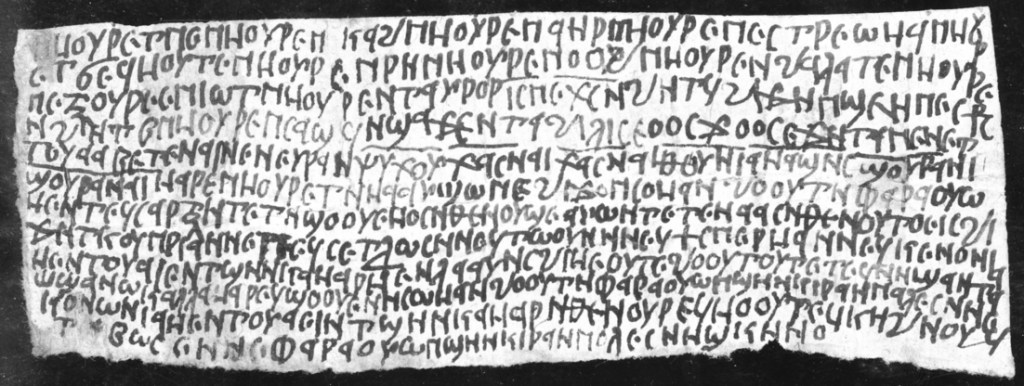
Magical systems are a reflection of the societies in which they are invented. Like all Mediterranean cultures at the time, Egypt in the Late Roman and Post Roman period was heavily influenced by Greco-Roman values of personal accomplishment and reputation. In the Coptic corpus we find a large range of spells aimed at removing blocks to a petitioner’s success, either in civic or romantic/sexual life. Frustration seems to be the driving force of many of these charms. “Make her love me” (or more commonly want me), “bind my rivals so that I will succeed”, “take that thing that he has and deliver it to me”. The drive for success led some to take unconventional paths.
So what does any of that have to do with horses?
How would turning a woman into a horse benefit such a person? My first thought was that there must be a kind of “if I can’t have you then no one can” thing happening, but sorcerers did not work for free, and it seems a lot of risk and expense for such a petty goal. Dr. F has, unsurprisingly, a more nuanced interpretation. The spell belongs to that category of binding spells which were one of the most common types of spell found in the magical literature of Coptic Egypt. In the case of the horse-woman, the driving impulse is to remove the block that stands between the petitioner and his target. The spell is intended to force the husband to reject his wife, or her parents reject their daughter, thus removing her from the web of social constraints that bind her to her current life. It’s implied that once the woman has been removed from the status quo, she would be forced to seek out the suitor, and then have her condition reversed.
It seems like a long way round the barn, and indeed, this specific spell seems like a confused blending of the binding spell and love spell.
Love spells were usually more straightforward; pretty direct in their language and their intentions. Calling them love spells at all is euphemistic, there’s very little romance hinted at. The language again was formulaic, so we find similar imagery in spells recorded from the third to the seventh centuries. The petitioner wants his target to “hang on me like a drop of water hangs from the lip of a jar” and to be “like the honeybee seeking honey, a bitch prowling, a cat going from house to house, a mare going under stallions.” The emotional state the spells seek to induce is one of instinctive compulsion, the exact kind of motivation that the traditional society sought to inhibit and control. Equines in particular are seen in Roman myth as the very embodiment of unconstrained lust. Long and frankly uncomfortable sections of Apuleius’ Metamorphoses deal with the erotic misadventures of its hero after he’s turned into a donkey, and these associations made their way into the Coptic tradition.
Animals feature prominently in other Coptic magic spells, as they had in the ancient Egyptian religion, which continued to be practiced in Roman times with some evolution and modifications. The horse, interestingly, is a later addition, as horses are not common in earlier Egyptian religious imagery. The focus on animals is not unusual, of course, animals appear as metaphors in regular language all the time, and in the magical traditions of many cultures. Animals are “easy to think with”, in the words of Claude Levi-Strauss. Shamans may invoke the strength of the bear, or invite in the spirit of a wolf, to effect some transformation of themselves and accomplish a goal. Priests in more organized systems may still declare themselves the incarnation of Gods, and may declare enemies to be dogs or slaves.
Anthropologists of the past tended to take these declarations at face value, and believe that the shaman or priest honestly believed they had transformed. The “magical mind” in this interpretation is simply unable to distinguish ritual metaphor from reality. More contemporary anthropology recognizes this as reductionist, presentist, and infantilizing, the colonialist trifecta. Ritual metaphors describe an understood relationship between an image and an outcome: the function of Asclepius is to heal, the ritual is intended to transfer that function from the spiritual into the physical realm. Similarly, the bear will overwhelm a weaker foe, ritually invoking this observed fact transfers the relationship between bear and enemy to the desired outcome in the physical world. It’s clear that the writer of those love spells did not mean to literally transform his target into a chimerical animal creature, but rather to induce an emotional state best described by comparison to familiar animals. Palladius’ version, where Macarius explains that the horse was only a shared delusion, hints at this more sophisticated understanding of magical practice.
But, we can’t leave out the question of belief. Priests and sorcerers may have understood the subtle relationship between their rituals and reality, but villagers and peasants who may never see the ritual in person, and only heard about them second or third hand, could very easily believe in the physical reality of transformation magic. In the absence of better understanding, all kinds of terrifying things might be possible and must be defended against.
The wisdom of Macarius in both versions of the legend is unsurprising, the monk’s saintly nature is the whole point of the stories. Monks in general are seen as the natural breakers of curses and spells. We’ll talk about monasticism more generally in a future episode, but for now it’s enough to point out that many of them were (ironically) public figures. I say ironically, since detachment from the mundane world was kind of the point of becoming a monk. Nonetheless, over and over again in the lives of saints, from Severinus to Simon the Stylite, we see these men attracting large crowds of supplicants seeking wisdom, healing, or just a reflection of God’s grace. The purpose of the monk was to oppose Satan in his every possible guise, and In a world where the machinations of a sorcerer were just as real as biological disease (and often the same thing, in fact), it’s not surprising that remedies would be sought from the committed enemies of evil.
A surprise does emerge when we consider the sources of the spells themselves. The tradition of curses and magic stretched back to Pagan traditions, of course, yet the enemies of the monks in these stories are almost never referred to as Hellenic priests or equivalent figures. Not in the East, at least. Nor do their workings closely resemble any established temple rituals. Instead, the spells and amulets described indicate a deep familiarity with the liturgy and conventions of the Christian church. Some amulets are simply lines of scripture copied out and placed in a container of some kind. Appeals are made to Angels and God for intervention. The connection continues on into the later eras of esotericism. I was deeply disappointed back in high school when I came across a copy of A.E. Waite’s Book of Ceremonial Magick and discovered that magic turned out to just be religion with extra steps.
Looking at the anti-magical workings of the monk – incantations, prayers, holy oils – it becomes difficult to discern a difference from the workings of the malevolent sorcerer.
Some monks are explicitly indicated to have worked as sorcerers. Among the Coptic corpus we find a curse laid by one Father Victor, a protective amulet that declares that it was sealed by “Father Anoup in Oil”. Magical manuals can be found in the inventories of monastic libraries, and were consulted by the residents therein. In many places in the late Roman and post roman world, the sorcerer and the monk, the pharmakos and the klerikos, to use the Greek, were one and the same.
That makes sense when we think about it though. If all of these curses being broken by the good Fathers were the work of Pagan priests, then that would ascribe some efficacy to the Pagan Gods. We have not yet quite reached the point where the Christian Church could confidently declare that the old Gods were devils that had deceived mankind, that would come later. All magical power had to come ultimately from a divine source, as twisted as its application may have been. What has been laid by the magician can be removed by the monk, but both are only possible by the permission of God.
The story of Macarius and the mare speaks to the fluidity of popular religious belief. Beyond or beneath the ongoing debates about the nature of Christ and the Trinity and careful scholarly glosses on the scripture, there was a deeper, more earthy spirituality that worked in the lives of the vast majority of people. In the lives of the illiterate masses, magicians, demons, half-remembered rituals, and ancestral traditions were real and active forces in the world, all under the rule of God.


Leave a comment