516 to 548
You are all sharp people, evidenced by your continued listening to this podcast. So I am confident that you are sharp enough to have already guessed that the main subject of this episode will be Theudebert the first, the son of Thiuderic, and therefore the eldest grandchild of Clovis. He will be the bulk of the episode, and we will talk about his life both before and after he came to power, the growing reach of Francia generally and Theudebert specifically, and a bit about his relationship with Justinian, with whom he was contemporary. First though, we’ll need to finish off his father.
When we left off last time, we’d whittled the number of Frankish kings down to three. Well, a Burgundian ax had, if we want to be accurate. Just to review, those sons were Thiuderic, Childeric, and Clothar.

Chlothar, the youngest, has so far shown himself to be the most unsparing in his viscousness, having stabbed his two young nephews to death with his own hand. Childebert seems to have had the loudest conscience, as we saw him attempt to protect one of his nephews from Chlothar. We can’t place him in the saint category though, as his protection ended as soon as his own life was threatened, and the whole thing was apparently his idea in the first place. The eldest, Thiuderic, was half-brother to the two of them, and has shown himself to be just as aggressive and unsubtle, and maybe just a little bit dim. Each of these brothers ruled a segment of the unitary entity known as Francia. The term for these sub-kingdoms that you’ll sometimes see is Teilreich. Not a term that any of these kings or their subjects would have recognized at the time, and not one I’m likely to use much either, but I thought I should mention it for completeness and interest’s sake.
The story continues today with Thiuderic and especially his son Thiudebert, who is widely considered one of the strongest of Merovingian kings.
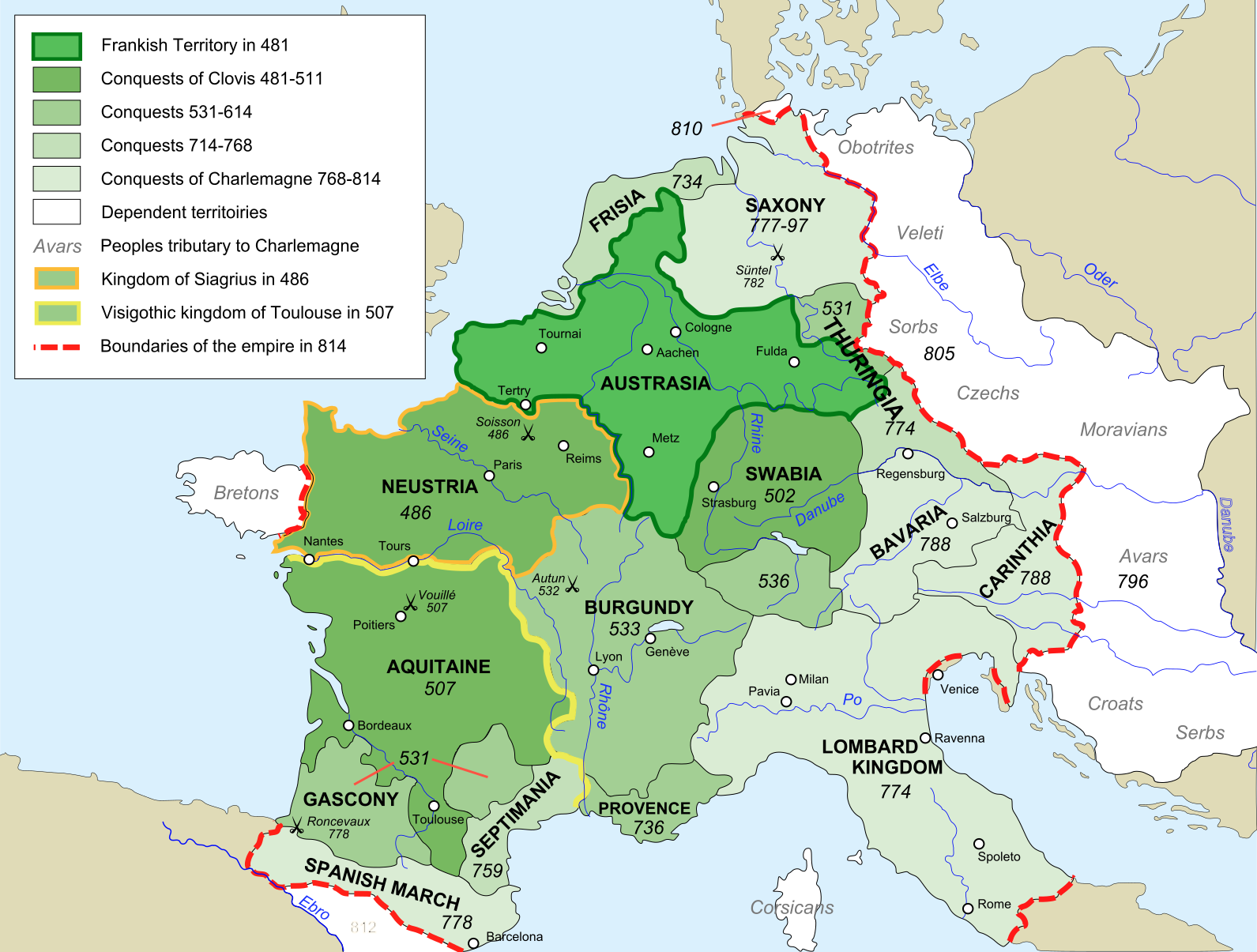
Father Thiuederic’s Teilreich was, broadly speaking, concentrated in the northeastern part of Francia, and across the Rhine with dominion over the Thuringians. It’s a region that will soon enough be known as Austasia. When we last saw him, he was walking away from the body of the last king of the Thuringians with his hands in his pockets, whistling casually. “The poor fellow seems to have fallen from the town wall, he must have slipped, how awful.”
Sémhur, CC BY-SA 3.0 https://creativecommons.org/licenses/by-sa/3.0, via Wikimedia Commons
In between all the warring and not throwing people off town walls, Thiuderic found time to set his son up with an advantageous betrothal. The lucky lady was the daughter of a king of the Langobards, a people we’ve managed to avoid talking about up until now. A digression thus makes itself known. The Langobards, later to be known as the Lombards, are going to become important in the not too distant future.
According to their own legends, the Longobards were part of that complex of Germanic tribes that originated in the north and moved southward, driven by overpopulation. They originally called themselves the Winnili, and were led by a woman named Gambara and her sons. In their migration, the Winnili came into contact with the Vandals, who offered them a choice: cake or death. No, the choice was pay tribute or face death; so I suppose it is cake or death in a way. The Winili refused to give in to extortion and prepared to fight. They were greatly outnumbered, and so they sought the help of their gods, as you do. The father god, Godan, said he would give victory to whomever he saw first on the morning of the battle, so Gambara sought the help of the goddess Frea, who turned Gotan’s bed to face the Winnili’s camp. When he saw them, the God asked, “Who are these long beards?” and gave them both victory and a new name – Langobardi, the long beards.
That’s a fun story, but disbelieved by its source, the very Christian Paul the Deacon, who thought the beard part made sense, not so much the pagan gods. Those gods by the way are an iteration of the familiar Odin/Wotan and Freya from Norse and broader Germanic myth. Modern linguists and historians suggest that the tribe’s name actually derives from Langbarðr, an epithet of Odin/Wotan, though still meaning “the long-bearded”. Thus it is an example of the familiar practice of tying the tribe’s ancestry to a founding hero or god.
That’s all as may be. By the time Thiuderic was matchmaking for his son, the Langobards were living in the north of what is now Czechia, in an uneasy tributary relationship with the neighboring Herules. Both would have been feeling the pressure from the Gepid kingdom further east, and connections to a powerful king of the Franks was very desirable.
Gregory names the Langobard princess Wisigard, daughter of Wacho. He does not record how Theudebert felt about the betrothal, but arranged marriages being the norm, he probably didn’t think much about it at the time. Besides, he had plenty to keep him busy.
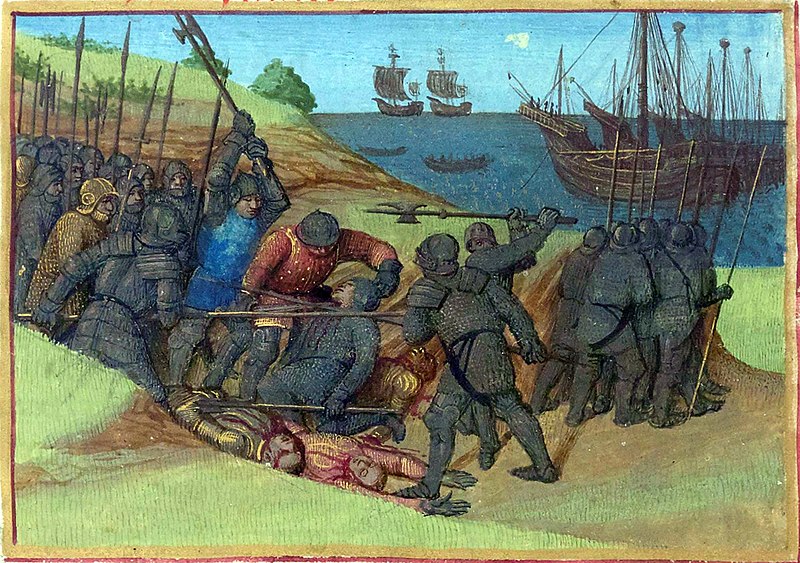
Young Theudebert had already proved his military credentials by defeating an army of Danes that had come raiding into his father’s northern territories. They were led by a king named Chlochilaich, who is identified by 19th century historian N.F.S. Gruntvig as the historical basis for king Hyglac, from Beowulf. I’m fairly sure I’ve talked about this before, but you know, repetition is how you learn. The Danish king was killed in the battle, and thanks to his enormous size, his body was preserved and displayed in the Frankish King’s hall, as part of his treasure. Being a pagan, Chlochiliach was not entitled to proper funeral rights as far as the Franks were concerned. That battle was in 516, and Theudebert would have been about 16 years old.
Jean Fouquet, Public domain, via Wikimedia Commons
His father had another job for him; since the death of Clovis, the Visigoths had been sneakily reoccupying their old territories in Aquitaine. Given the relatively light settlement of Franks in the south, this probably entailed very little violence, just a Visigothic leader showing up at a town’s gates with an entourage and announcing “We’re back.” Obviously that couldn’t be allowed to continue, Thiuderic sent Theudebert to do something about it. He teamed up with his cousin, Chlothar’s oldest son, and headed south to drive out the trespassers.
The cousin reached Rodez and turned back, for reasons unknown. Theudbert carried on toward Béziers, in Septimania, and captured one of its outlying fortresses, at a place called Dio-et-Valquières. The fortress was sacked, and Theudebert sent a warning ahead of him to the nearby town of Cabrières, threatening to burn the place to the ground if it did not surrender.
There was a woman who lived in Cabrières, named Deuteria. Deuteria was from a wealthy and well-connected Gallo-Roman family, one which would not so long ago been of senatorial rank; she was related to our old old friend Sidonius Apollinaris. Deuteria was apparently the authority in Cabrières, her husband having gone to Béziers to assist in its defense. Deuteria did not care for the idea of her town being burned down around her ears, and surrendered the town to Theudebert.
When they met, there was a meeting of minds, as well as other parts of the anatomy. Deuteria’s husband and the Langobard princess were forgotten.
In this story we are at the mercy of Gregory’s episcopal censoriousness, so it’s hard to know what exactly the situation was, but it seems that the two genuinely had an emotional connection as well as physical, this wasn’t just a spoils of war situation like we saw with Chlothar and Radegund last episode. What this all meant for Theudebert’s campaign is unclear. Gregory does not mention Béziers falling to sack, but he also does not indicate that Theudebert withdrew from Septimania. Maybe he was simply enjoying Cupid’s grove in Cabrières, while his men kicked their heels, and presumably made themselves obnoxious to the locals.
Meanwhile, papa Thiuderic was carrying on according to his idiom. The man he had left in charge at Clermont-Ferrand was making the locals unhappy. His name was Sigivald, and he was overtaxing them, confiscating property, and generally making himself a nuisance. Thiuderic took care of the situation directly. There was no personal improvement plan put in place, no meeting with management and HR to align values or close the loop on objectives. There was simply the drawing and utilization of Thiuderic’s sword. He was a hands-on kind of manager.
Actually, whether Thiuderic executed Sigivald for misgovernance of Clermont or not is moot. He was certainly executed, that part isn’t in doubt, but Sigivald was a relative of the dynasty, and it may have been for dynastic, or simply personal reasons that Thiuderic had him killed. He also knew how blood feuds worked, and knew that Sigivald’s son, also named Sigivald, would be honor bound to avenge his father. He also knew that the younger Sigivald was down south with Theudebert’s army. Convenient, thought Thiuderic, and he sent a note down to his son asking him to please trim that loose thread, thanks so much.
Theudebert roused himself from … whatever he was doing … to read his father’s letter. He then sent for Sigivald the younger. When the young man arrived, Theudebert passed him the letter. I imagine that Sigivald paled, and for a moment wondered what Theudebert’s intentions were in sending for him. He needn’t have worried, Theudebert advised him to make himself scarce. “When [my father] dies and you learn that I am reigning in his place, you can return to me safe and sound.” Sigivald didn’t need to be told twice. He rode to Gothic-occupied Arles, but then decided that it was still too close to Thiuderic to be safe, and made his way to Italy to hide there.
Shortly afterwards, Theudebert received news that his father had fallen ill, and things weren’t looking good. Theudebert was not a stupid man, and he knew his uncles Childebert and Chlothar well enough to know that if he wasn’t Johnny-on-the-spot when his father met his maker, most of his inheritance would find its way up their sleeves before he even got a peek at it. He rode for home, probably either Metz or Rheims. He left Deuteria behind with her two children, an older daughter by her former (?) husband, and another girl that she had borne Theudebert as a result of their affair. So it had been going on for a while now.
Theudebert moved north as quickly as he could, but it wasn’t fast enough. Thiuderic I died in 534, aged 46 or 47. I described him as possibly a bit dim, without really justifying such slander. Last time, I mentioned that after the defeat of the Thuringians, Chlothar avoided a ham-fisted assassination attempt by Thiuderic. That attempt had involved a man hiding behind a curtain that was too short to conceal his feet. So I can’t bring myself to apologize for the description. Thiuderic had been a king of the Franks for 23 years, and his position now fell to his much brighter son.
Chlothar and Childeric were certainly emotionally prepared to move against Theudebert and take at least part of his inheritance from him, but in the words of Gregory of Tours, Theudebert “bought them off, and with the help of his people established himself on the throne”. Violence was avoided. Given our experience with the Franks up until now, the phrase “violence was avoided” seems absolutely wild. It may have been that the two were distracted by activities in the south. In the previous year, they had allied for another attack on the Burgundians. This time, when the two armies met near Autun in 532, the victory went to the Franks. There would be no further reprieve for the Burgudnian kingdom, and over the two years following the battle it was progressively absorbed into the Frankish kingdom. Godomar, the last king of the Burgundians, disappears from the historical record, and we do not know what ultimately became of him. Theudebert may have gotten a bit of a break at his accession simply because Childebert and Chlothar were too busy with that process to have extra energy to devote to screwing over their nephew.
Childeric opted for even greater rapprochement, and decided to adopt Theudebert as his own heir, since he had no sons of his own. Gifts flowed from uncle to nephew, and Theudebert’s loins settled that much more firmly into the seat of power. He passed his uncle’s generosity on in the traditional way, including to Sigivald, who returned from hiding in Italy and received all his father’s lands back.
To complete his court, Theudebert sent for Deuteria and her children to join him, now that he felt secure. He married his mistress, her husband having presumably died in the interim, and they had another child, a son, who they named Theudebald. The abandonment of Wisigard, Theudebert’s official fiance, was both a domestic and international scandal. We talked earlier about how this kind of marriage – the Friedelehe – was known and fairly common, but not necessarily approved of. The idea of invoking the Frankish royal custom of polygyny seems not to have come up. One wonders whether it was the Langobards who objected to the idea of their princess being a second wife, or the Gallo-Roman Deuteria herself. Probably both. Seems likely.
I’m going to jump ahead in the timeline and bring the story of Deuteria to the end. The relationship seems to have been deep and, ultimately, what we might today call unhealthy. I don’t think it would fly on Reddit, is all. Gregory tells us – in the dispassionate just reporting facts mode that he often uses for gossip – that as her eldest daughter grew older, Deuteria worried that she would become a rival for the king’s affections, and had her drowned. Yeesh.
This kind of thing would do nothing for the public perception of Theudebert’s personal predilections, and hostility to the relationship built and built. “Public”, I feel compelled to remind you all, does not mean the majority of the population of Theudebert’s lands, he couldn’t care less about the opinion of a few hundred thousand unarmed peasants. Public opinion in this case means the opinion of a few hundred householders and bishops, who controlled the vast vast majority of the money, military, and moral power in the kingdom. Finally, the king was forced to concede to the pressure. He put Deuteria aside (a common phrase that seems deliberately calibrated to disguise the emotional brutality of the act) and married the patient Wisigard. How she felt about the long delay, or about her very public second-bananaship, Gregory does not record. Unsurprisingly.
However she felt, Wisigard did not have to endure the feelings very long. She died after only a short time, we don’t know exactly how long. She did manage to exert a bit of influence in her time, though, which I’ll talk about later. Theudebert, probably mindful of public opinion, resisted the temptation to take Deuteria back and married another woman, whom Gregory does not bother to name, and with whom he had no children.
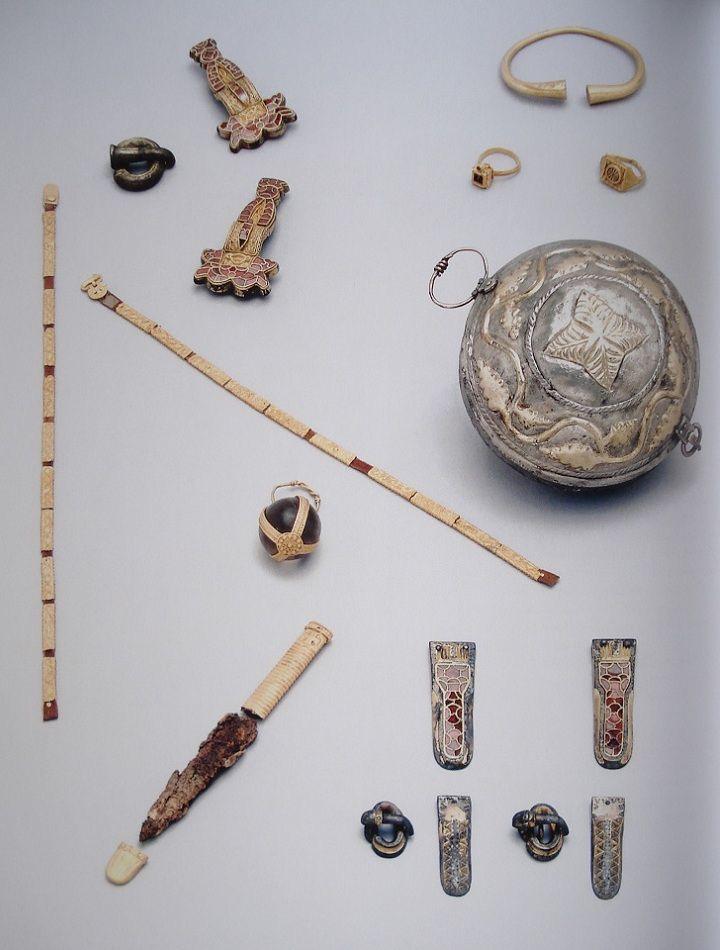
Theudebert’s home territory included the city of Cologne. Cologne cathedral includes a tomb, dating to the early sixth century, in which two bodies were found, a woman in her twenties and a young boy, along with grave goods. Given that they were interred in a church crypt, and not mashed into the mud of Belgium or wherever, the treasure is in remarkably good shape and truly gorgeous. Some of the items have been identified as Langobardic, based on similarities to other finds, and so this is sometimes said to be Wisigard’s tomb. There are problems with that identification, as with every tomb of the period that’s tied to an individual. There’s the mystery of the boy for instance, who genetic testing revealed to be unrelated to the woman, so what’s going on there? Who the heck is he? I mentioned it because the artefacts really are beautiful. Instagram, etc.

Outside his domestic arrangements, Theidebert had to deal with the often tense relationship with his uncles.
When Theudebert flipped his Childebert to his side, Chlothar didn’t just go away. Given what you know about Chlothar, it shouldn’t be surprising that the other two kings were wary of him. Theudebert and Childebert made preparations for a preemptive strike. Chlothar knew they were coming and took up a defensive position in the woods. The other two’s armies were large enough to surround the wood, and Chlothar looked to be trapped. Things looked dire for the youngest son of Clovis.
On the night before battle was set to take place, a violent storm blew in. “Their tents were blown down, their equipment was scattered, and everything was overturned. There was thunder and lightning and they were bombarded with hailstones… They had no protection except their shields, and they were afraid they would be struck by lightning. The horses were scattered far and wide, some were recovered two or three miles away, many were never found at all. The two kings were cut about by the hailstones as they laid on the ground. They did penance to God and begged Him to forgive them for having attacked their own kith and kin.” Gregory credits the storm to Clotilde, who, desperate to prevent civil war among her family, prayed fervently to St. Martin to intercede, and Gregory’s favorite saint came through. The bishop of Tours was always prepared to add a little shine to the saint whose relics were in his keeping.
Chlothar and Chilidebert took a brothers’ Holiday to Spain to try and mend fences, as you do. Nothing like beating up Visigoths and taking their stuff to make you forget the time your brother went to war against you. The campaign was at best a middling success. The Franks brought back plenty of pillage, but were driven away from Zaragoza by an appeal to Saint Vincent. Gregory reported great pillage but no territorial gain for the effort.
While his personal life was, shall we say, somewhat complicated, Theudebert’s status was growing, both within Francia and the wider European context, and so we shall turn to foreign affairs. While the Merovingians fussed with each other over their various territories and harassed the neighbors, opportunities were beginning to appear. Visigothic power had been significantly bolstered by the direct involvement of Theodoric the Great in Hispania, but he died in 526 and was succeeded by his daughter Amalasuintha, as we’ve discussed in some depth. The spiralling crisis in Italy made the kings of the Franks prick up their ears, since Amalasuintha was kin, through her mother. When Theodehad murdered the queen, all three Merovingians signed a letter demanding compensation, the queen’s weregeld, or there would be war.
Theodehad had enough on his plate without Frankish intervention, and agreed to pay 50,000 pieces of gold, which Theudebert and Childebert conspired to keep for themselves, cutting Chlothar out of the action. Really, I wonder if there even was a word for trust in the Frankish language?
Chlothar wasn’t having it, raided and took control of parts of Childebert’s lands, far more valuable than his share of the tribute would have been.
Theodehad’s tribute did not guarantee his safety, of course. Justinian was laying the groundwork for his Italian war, following up the empire’s success in Africa. The Franks seemed to be ideal allies; they had a proven reputation for military prowess and followed the orthodox faith (mostly). Justinian sent cash to the Merovingians, with promises of more once they intervened. And the Franks proved to be united and faithful allies, working alongside Belisarius’ troops as they battled the forces of long-hated Arian heresy, for the good of the Empire.
I’m kidding, obviously. If you remember our episodes on the first Gothic War, the Franks first induced the Burgundians to take advantage of Italian chaos. Later on, Theudebert led his own men into northern Italy to pillage the already war-ravaged country in 538 and/or 539. Militarily the mission went well enough, both the Goths and Byzantines had reason to think Theudebert had come as an ally, but the Franks had come entirely for their own purposes. Theudebert fought both, routed the Goths on the banks of the Po, and drove the Byzantines into Tuscany. It turned out though that famine and plague were just as much a problem for the Franks as they were for the locals, and as his men began to die unpleasantly of dysentery around him, Theudebert withdrew. He would send other expeditions into Italy, under the leadership of other commanders. Here is an example of Gregory of Tours’ information becoming ever more sketchy the further from home is his subject. Gregory reports that the second expedition conquered the whole of the peninsula, all the way down to Siciy. We know from Procopius and his successor historians that that is simply not true. At most the Franks exercised some temporary military authority over the upper Po Valley. It’s likely that Gregory was getting this information second or third hand from the descendants of those raiders and commanders, and that some, or a lot, of exaggeration made its way into his account. What is true is that Frankish armies were active in Italy, and making life for the Italians – already pretty far from a rose garden – even more miserable. The plunder from both of these expeditions all found its way into Theudebert’s treasury, making him ever richer than his uncles, and able to push his influence further and further afield.
The Franks’ absolute refusal to do anything for any reason other than their own interest was irritating to Justinian. Worse was the continuous push of Theudebert’s influence eastward, as he exerted pressure on the Alamanni and Langobards to dance to his tune. Two letters survive from Theudebert to Justinian; in one he lists all the lands and peoples over which he claims dominion. He lists Thuringians, Visigoths, Saxons, and Jutes as all acknowledging his dominion, and of holding sway over territories stretching from the Ocean to Northern Italy, extending all the way to the frontiers of Pannonia. Now, simply claiming dominion over a people or territory does not make it so. The degree of Theudebert’s control over any of these groups is entirely moot, and it’s to be expected, in a diplomatic communication, that the Frankish king will make himself seem as big and important as he possibly can. Even allowing for that, it’s an impressive swathe of territory. Theudebert does not mention any lands known to be in the sphere of either of his uncles, so we can guess that he is speaking only for himself. He could potentially, if his influence continued to spread eastward, become a threat to the empire’s interests.3
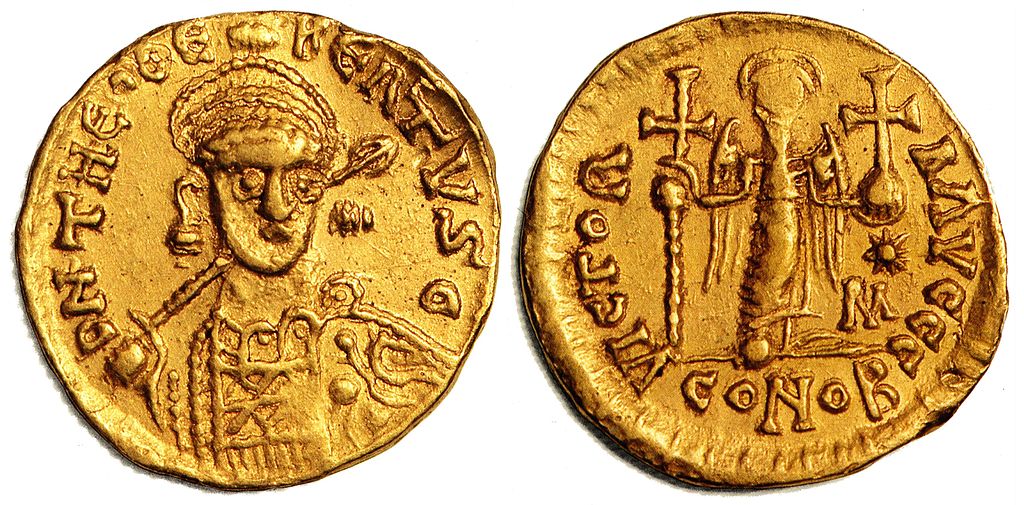
Theudebert’s letters, among other things, indicate that he expected to be treated as a king, not a subject. Up until now, the fiction had been maintained that all the kings of the western kingdoms were subject rulers. They were governing on the emperor’s behalf, as kind of viceroys or satraps. True they took no orders and returned no tax revenue, but the Goths and Franks considered themselves the preservers and continuation of Romanitas, just in a different form. So symbolic standards were still maintained. There was a convention, for example, of minting gold coins with the image and name of the emperor, not the western king. Theudebert was the first Frankish king to abandon that convention around 530, circulating gold coinage under his own name and image. In Hispania, that shift didn’t take place until the 580s under Liuvigild.
The expanding power of Theudebert, his evident willingness to flex that power, and his disregard for imperial feelings, led to a rumor, reported in Byzantine histories, that he was planning to invade the empire itself, and take control of Thrace. That never happened, but the fear that it might is meaningful. The Frankish king suddenly had to be taken into account, not just as a tool to use in Italy or Hispania, but as a potential rival. Theudebert probably had no designs on imperial territory. Even if he never touched imperial soil, for the first time since 476 there was a power competing with the empire for the loyalty and attention of the tribes beyond the Danube. There was potential for the Gepids, Langobards, and other eastern Germanic people to play politics and pit East against West. The last time such a powerful destabilizing agent had appeared on that frontier, it was the Huns. No wonder Justinian and his courtiers were worried.
While the empire fretted, the Frankish church celebrated their powerful ruler. “Once he was firmly established on the throne, Theudebert proved himself to be a great king, distinguished by every virtue. He ruled his kingdom justly, respected his bishops, was liberal to the churches, relieved the wants of the poor and distributed many benefits with piety and friendly goodwill. With great generosity he remitted to the churches of Clermont-Ferrand all the tribute which they used to pay to the royal treasury.” I’ve also already told the story of the king’s investment in the city of Verdun, and how he refused repayment of that loan. As far as his own bishops were concerned, Theudebert was a king worthy of praise.
And yet, in Gregory’s telling, there is some equivocation. Book 3 of his Historiae, from which just about all of this comes, is an odd piece of writing, as it sees-saws back and forth from praise for Theudebert’s generosity and his victories, to stories of shady personal activities and noble rivalries at his court. Most obvious is the matter of Theudebert’s relationship with Deuteria and his treatment of Wisigard. It’s as if Gregory is saying that Theudebert did all these good things that I and my fellow churchmen heartily approve of, while also seeding in hints that the reality was not quite as perfect and shining as the official line suggests.
To give an example, there is the case of Asteriolus and Secundinus. These two were in high positions in Theudebert’s service, and simply could not get along. Secundinus was a proud man, who rubbed his position of favor in the faces of everyone, and it rubbed Asteriolus the wrong way. The two argued constantly, eventually coming to blows. Asteriolus gave the proud Secundinus a good beating, but the fight resolved nothing. Theudebert took sides in the argument, supported Secundinus and humiliated Asteriolus by making him subordinate to his enemy. Now we have no real context here. We don’t know the actual issues between the two men, or the personalities in any detail. But surely this is a bit ham-fisted of the king? One of the king’s most basic functions is to act as a mediator between the powerful men of his kingdom, to keep internal harmony as far as is possible, and here Theudebert seems to be doing the opposite. Here is also the only time we see Wisigard exercising any influence at court, as through her intervention Austeriolus was returned to the king’s favor. Yet resentments still boiled under the surface. As soon as the queen died, Secundinus made his move and killed his rival. He made the crucial mistake however, of leaving Austeriolus’ son alive, and when he had grown, he made his intentions to take revenge clear. Secundinus was forced to flee, pursued from house to house and town to town, until he finally chose to free himself via poison rather than fall into the hands of his enemy.
This is exactly the kind of blood-feud that kings all over the post Roman world were enacting laws to try and address. Yet Gregory makes no mention of Theudebert making any effective attempt to moderate this dispute or resolve issues. The one thing he did just made everything worse. So there are hints that all was not sweetness and light. Theudebert was not all knowing or universally benevolent. Gregory is willing to acknowledge the grit in the oyster.
There are two stories of how Theudebert met his end. Gregory simply reports that he took ill and died, which is the version I’m inclined toward, given Gregory’s comparative closeness to the subject. The second version comes from Agathias, Procopius’ continuator. He claims that Theudebert was killed by a bison while hunting, and that sent me off on a digression. Ignorant american that I am, I was under the impression that the European bison (or wisent) was one of those fantastic extinct mammals, like the giant sloth or saber-tooth cat; a creature that humans interacted with once but that had long been extinct by the time we got around to writing things down. Turns out I was very much incorrect in this, and that the not only was the European bison around to gore Frankish kings to death, it survives into the modern day, though it was very dicey for a while. Its range shrank consistently as European forests were cut down, until by the 19th century it survived only in a few pockets in Poland and the northern Caucasus mountains. It has made a comeback though, beginning in the 1950s, in an effort spearheaded by Poland, and there are now herds in several European countries, including Spain and Portugal. Nice. Physically, the European bison is taller than its American cousin, and if you haven’t been near one, the American version is already frighteningly tall.

ThomasLendt, CC BY-SA 4.0 https://creativecommons.org/licenses/by-sa/4.0, via Wikimedia Commons
Anyway, apologies for the digression into wildlife conservation, but I thought it was interesting. Whether by bison or disease – or both, I suppose, Robert Baratheon style – Theudebert I died in 548, probably approaching but not quite reaching his 50th year. He had been king of his Franks for fourteen years. He had made himself a force to be reckoned with, and considered one of the Merovingian’s most effective rulers. His son by Deuteria, Theudebald, inherited his crown, without a peep of objection or interference from any of his relatives, which in itself is a comment on Theudebert’s effectiveness.
There was a final sting in the tail, and a reminder that his administration was far from perfect. Theudebert’s death removed royal protection from his chief tax collector, who was tracked down by an angry mob in Trier and stoned to death. Gregory has little sympathy for the man, making sure to note that in addition to being a cruel exploiter, he habitually used to break wind in public. Sic transit gloria mundi.
We will end there, with the death of a gassy tax man. Next time I want to briefly turn to the question of Gregory and his class, what were these bishops like? Men of god, of course, exercising a moderating influence on the violence of their militaristic kings. Well … sometimes yes, sometimes really, really no.
 The Dark Ages Podcast