c. 500-590
Hello and welcome to the Dark Ages Podcast. I wanted to take a moment and acknowledge that at the time of release, the cardinals will be just about to begin the Conclave to elect a new Pope. Pope Francis of course having passed away on Easter Monday. Normally I try to avoid referencing current events, with just one other exception so far, but since today’s episode is focused on religion, it seemed weird to say nothing. As a non-religious person, my impression of the Pope was from the outside looking in, but he seemed to me to be a thoroughly decent man who did his best in a very demanding job. My impression is of a leader who earned and deserved the respect of both the faithful and the not. I understand that his last official act was a warm greeting to the crowd that had gathered in St Peter’s Square to celebrate Easter. It seems entirely in character to me. May he rest in peace. On with the episode.
Louvre Museum, CC BY 3.0 https://creativecommons.org/licenses/by/3.0, via Wikimedia Commons
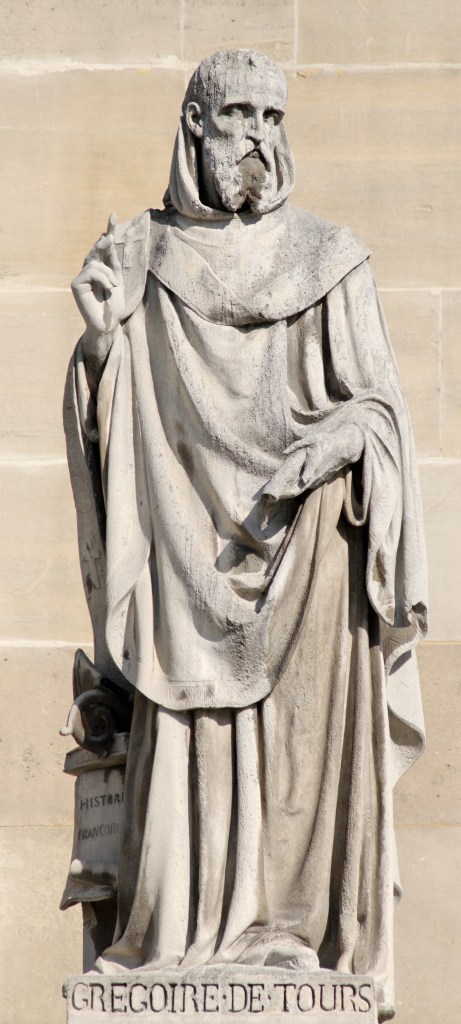
So far, as we’ve made our way through book 3 of The Historia Franciae, I’ve been pretty much reporting the stories as reported by Gregory of Tours, without a lot of comment. I’ve corrected or left out the parts that Gregory got wrong or confused, but the fact is that most of the events he reports can not be corroborated in other sources, one way or the other. This is the nature of The Early Medieval Era, and at this point I hope you’re familiar enough with that fact to take it as read.
There is a side effect, which is to unconsciously take the good Bishop of Tours to be a disinterested observer. Surely as a bishop, a man of the church, he would not have any political agenda, and free of all but the most religious concerns.
I’m sure you can hear the “but” coming, and indeed I’m sure a fair few of you are actively scoffing at such a naive conception. Well, dear cynical listener, I’m afraid you are right. There is a big “but”, and I can not lie.
The bishops of the Merovingian kingdoms were political players just as much as were the military men of the Frankish establishment. I’ve already hinted at this a bit, when we talked about the influence of the bishop over the maintenance of the cities. Along the way though, I’ve painted them pretty uniformly as an unambiguous force for good. This episode will contain some arguments and incidents that will run counter to that impression. Later on in the Histories, when Gregory begins using the first person, his humanity becomes clearer.
I’ll talk about what we know about the structure of the church in the sixth century and how it came to be. We’ll talk about the background of the bishops and other senior clergy, and the sources of their authority. And I’ll finish with a few incidents that paint the bishops in a little bit less saintly light than they’ve appeared in this podcast up until now.
Before we start on all of that though there is one issue I need to mention. I’ve had a couple of comments about my attitude toward the church and toward doctrinal debates specifically. I recognize that I can at times be a bit cynical about the motivations of the various religious leaders we encounter in this podcast. It is a natural consequence of studying medieval history, to be honest, because the cynicism of some of the secondary historians I read makes me look like Pollyanna and Spongebob Squarepants, to mix my generational reference points. There is no doubt that some churchmen were corrupt, it’s inevitable in an institution as large as the church. But I try very hard to remind myself that, corrupt or not, each and every one of these people also believed in the faith they practiced. That seems obvious, but one of the less attractive inheritances of the reformation has been this background assumption of corruption and worse, con-artistry, in our perception of the medieval church. I do my best whenever the issue comes up to remember that there is a background of belief that I, as a secular person of the modern era, have a very hard time feeling or even imagining.
As an example, we will speak quite a bit about relics in this episode. To those of us looking in from the outside, the veneration of relics can seem utterly bizarre. To Gregory of Tours, bishop and caretaker of the relics of Saint Martin, the supernatural power of these objects was obvious, their effectiveness in accessing the holy as clear to him as the effectiveness of my microphone is to me. The presence of God and His active interventions in worldly affairs was a fact, and indeed the writing of history for many was an exercise in demonstrating that fact and explicating those interventions. The clergy and monks were not trying to fool people, they believed what they were saying.

615~Columbano, CC BY-SA 4.0 https://creativecommons.org/licenses/by-sa/4.0, via Wikimedia Commons
That being said, the monks and clergy of the early middle ages, just like any other time in history, were people too. They were just as capable as we are of ambition, self-deception, all the various forms of bias, greed, and of justifying themselves ex post facto. We must deal with these characters as people, not as characters or caricatures, which can be difficult at this distance. It’s a complicated issue, and I’m trying my best to share my thoughts on it without making it the entire podcast, and I feel that I am failing. So maybe just to sum up that when the religious men in this episode misbehave, in most cases I am absolutely sure they would have behaved exactly the same way whether there was a religious angle or not, and that while their religion certainly shaped their worldview it was not the only thing that did so. Okay?
Probably a good idea to just get on with it at this point. Can you imagine the knots I’m going to twist myself in when we get to 622?
To start with the church, its structure and its history within Gaul, with just a smidge of vocabulary thrown in. This religion stuff really is a specialist subject, and for much of it, I am learning along with all of you. So if you are familiar and I get stuff wrong, I am thrilled to be corrected.
There is no clear documentary record of the first appearance of Christianity in Gaul. Based on the liturgical rites in use later, it seems likely the first missionaries were trained in eastern churches like those in Antioch and Jerusalem, though ties to the Roman community were maintained. The first mention in the records is of persecutions at Lyon in 177, which seems to have been the center of the faith in Gaul at the time. Forty-eight martyrs originate from that persecution, from every level of society, so Christianity was at least locally making inroads.
Local legends of individual churches often credit the Apostles or their immediate students with their founding, even when the story makes very little historical sense. For example, it was claimed that the first Bishop of Vaison had been a disciple of the original twelve, even though he attended the first Gallic Synod in 314, and thus had to have been at least 200 years old.
On slightly firmer ground, our friend Gregory lists seven original dioceses in Gaul, established by seven missionaries sent from Rome in 250. These were Tours, Arles, Narbonne, Toulouse, Clermont, Paris, and Limoges.
Constantine famously ended the persecution of Christians in 312, and in 314, that very first public synod was held at Arles. By then there were at least 24 dioceses in Gaul, 21 of whom attended the council. Christianity spread quickly through the upper echelons of Gallic society. Imperial approval led to aristocratic bandwagoning, as it often did. And in a pattern that would be repeated over and over in the coming centuries, expediency was changed to sincere belief within a generation or two. By the end of the fifth century, Christianity was pretty much universal among the urban and educated classes of Gaul. By 500, over 70 bishoprics presided over the old provinces. Practice, i.e. liturgies, specific songs and prayers, and so on, varied from one locale to another. Bishops had a great deal of leeway as long as they acknowledged the primacy of the bishop of Rome and stuck to the core theology. That leeway gave the church flexibility to accommodate and absorb local pagan practices as it grew.

Tipoune, Public domain, via Wikimedia Commons
In spite of that, adoption was much slower in the countryside. Among the coloni and other peasants, old Gallo-Roman traditions clung on, longer than elsewhere in the empire, with some pockets of the old ways persisting into the seventh century. Almost every hagiography from the period mentions at least one pagan shrine converted by the saint to Christian usage, and it took a long time for them to run out of shrines.
During the days of persecutions, bishops had been the leaders of underground cells, and could be of just about any social class. By the time Clovis was baptised, those days were long gone. Remember way back when we used to talk about the flight of the curiales? The landowning classes were less and less interested in serving the imperial bureaucracy. They had been mostly replaced by hired federates in the military. But they had to do something with their time, and something to maintain their local status. The growing church, growing right alongside the newly realigned aristocracy, was there to fill the gap. The bishops of Gaul were by and large the scions of the senatorial families, wealthy and privileged. There were exceptions but they were rare to the point of insignificance, and they were definitely NQOCD. Not Quite Our Class, Darling. Out of all the bishops of the Merovingian era, we have enough information about around 179 of them to make a definite statement about their social class. Of that 179, only eight were not of the senatorial aristocracy. “Of inferior but nevertheless free parentage” was the phrase applied to Iniuriosus of Tours, bishop from 529 to 546. Those numbers, by the way, come from Patrick Geary’s book Before France and Germany. It’s a few years old now, so the research may have moved on, but I didn’t find it if it did.
The higher status families expected to fill the upper layers of the church hierarchy, and competed with each other for them. No principle of clerical celibacy had yet been established, that would come later, and some bishoprics thus became effectively hereditary.
The social status of the bishops gave them the standing to lead their communities, and to negotiate with the Frankish military aristocracy, as we’ve already seen. Ultimately, the bishops took over many of the functions of the civil magistrates that had existed under the Empire. Functions like poor relief, maintenance of city infrastructure like walls and aqueducts, and building projects. In some instances, this shift of responsibility was direct – Saint Ambrose had been an imperial administrator before becoming bishop of Milan. In other places, imperial projects and operations were taken over on a more ad hoc basis. The projects, unsurprisingly, were now much more sacred, and in the archeological record we see increased church building, while buildings like theaters and baths were converted to other uses or abandoned.
Status and civic responsibility were the basis of the bishop’s secular authority, but what about their religious authority? Well, partly of course it came through the ritual of ordination, which stretched back in an unbroken line to the original apostles of Jesus, at least in theory. But there was a more immediate source of the bishop’s supernatural authority, and that was his control of the relics.
I mentioned this earlier a bit, when we talked about the loyalties of citizens in Hispania. The centuries of Roman persecution meant that just about every Christian community could point to at least one martyr in its history. Each city had a saint who could be called upon to intercede with God on behalf of the community, and their physical remains were believed, deeply, to have profound spiritual power. The risk of cynicism is high in this area, especially in light of later medieval excesses vis-a-vis the veneration of relics. Let me put it this way: the veneration of relics provided a focus for worship that could easily replace local pagan practice, and could bring patronage to the church or shrine that housed them. I must stress, though, that that does not imply a lack of faith on the bishops’ part. They believed in the supernatural power of relics just as much as their parishioners did, and ensuring that that intercessory power was available and well cared for was both a responsibility and a source of authority.
Bishops worked hard to maintain their monopoly over this spiritual power. Bishops saw themselves as the guardians of both relics and the revealed word of God, and it was their responsibility to ensure that those gifts were distributed and used effectively and correctly, through their education and pastoral work. Alternative sources of spiritual authority were threats to both correct practice and episcopal power. That combination explains the vitriol aimed at Arianism (and other heresies) by the orthodox establishment. But at least heretics were easy to demonize, more problematic was the growing system of abbeys and monasteries.
Christophe.Finot, CC BY-SA 2.5 https://creativecommons.org/licenses/by-sa/2.5, via Wikimedia Commons
I haven’t spoken about monasticism at all yet, I had intended to wait until a little later when we can talk about the famous Saint Benedict. Benedict, who was Italian, and died in 547, promulgated a rule for monks that was super influential and quickly spread, but he was absolutely not the founder of Christian monasticism. For centuries now, collections of religiously minded people had been gathering together to live under more or less strict rules and daily devotions. Frequently they gathered around famous preachers, hermits, and ascetics. We’ve already talked about Saint Clodovald, whose settlement would eventually be known as St Cloud, and way back when, we heard about Saint Severinus and the community that gathered around him. No formal process of canonization existed yet, all saints attained that status by popular veneration and acclaim.
As Christianity became more and more embedded among social elites, many of them established institutions of their own, to provide prayers and charity work, to live there themselves, or both. Radegund, who we met just a few episodes ago, is an example of that trend. Since these communities grew up around founding figures who subsequently became venerated as saints, they also possessed their own sets of relics.
Bishops were powerfully motivated to assert their authority over these potential rivals. The councils of Orleans in 511, 533, 538, and 541, and of Epaon in 517, all place abbots under the supervision of bishops. The fact that this rule had to be reiterated so frequently gives us some idea of how effective it was (not very).
A great example of the problem is, again, Radegund, and her abbey at Poitiers. Radegund was a Thuringian princess who had escaped marriage to Chlothar and founded an abbey at Poitiers. Radegund was a woman of strong reputation and had connections all over Christendom, including the empire, at the very highest level. She received from the emperor Justin II a magnificent gift: a fragment of the true cross. According to canon law, such an impressive artefact would need to be officially installed in Radegund’s abbey by the local bishop.
Radegund’s house fell under the authority of the bishop of Poitier, one Maroveus. Maroveus refused point blank to carry out the ceremony to install the relic. The generally held belief is that Maroveus knew that such a relic outshone all of the relics under his own direct care, and would set the abbey up as a rival and alternative authority to him. It turned out he was right. The well-connected Radegund wrote to Sigibert, who was by now king of Austasia – we’ll get there, don’t worry – and persuaded him to send an alternative to officiate. So the true cross was installed at Radegund’s abbey by Euphronius, who happened to be Gregory’s predecessor as bishop of Tours. The abbey is known as the Abbey of the Holy Cross to this day. Maroveus did not take being outmaneuvered gracefully, I’m sorry to say, when Radegund died in 587, the bishop refused to attend her funeral, and the bishop of Tours had to step in again. This time in the person of Gregory himself.

FrDr, CC BY-SA 4.0 https://creativecommons.org/licenses/by-sa/4.0, via Wikimedia Commons
These were the kinds of games that were played, very intensely and for high stakes. Technically bishops were elected by the local clergy, but outside influence was strong and could come from the very highest levels. Sees could be and were controlled by single families for generations. Gregory’s family is a superb case in point. Both his mother and father were from highly distinguished lines, and he was related to bishops of Langres, Geneva, and Lyon, and of the eighteen bishops that had preceded him at Tours, Gregory boasted that only five had not been his kin. This was in no way unusual, at Nantes, Châlons, Paris, Sens, Laon, Metz, Orleans, and Trier, it was normal and even expected for the bishopric to pass from fathers to sons or from uncles to nephews.
Bishoprics accrued massive properties over time, and generated incredible wealth for the office holder and his family. The complexity of the position and the enormity of the resources under his control explains the necessity of prioritizing administrative and political skills when selecting the new bishops, rather than piety or otherworldliness. When a bishop with a genuine vocation rose through the ranks of the clergy to top of the tree, it was rare enough that it was worthy of comment by the hagiographers and historians.
To get an idea of the stakes in these games, let’s take a closer look at one of these bishops. Felix, who succeeded his father as Bishop of Nantes in 549 or 550. His favorite estate, Charcé, was situated along the Loire in Poitou, and was described by the poet Fortunatus with admiration. It included over 3,000 hectares of vineyard and hills rich with the scent of pine. 3000 hectares is over 7,400 acres. Put another way, it is all of Manhattan south of 92nd Street. That was Felix’s favorite of several estates.
Fortunatus praised Felix for converting the “ferocious saxons” – by which he meant a small nest of Saxon pirates operating with royal recognition on the coast. He worked to redirect trade routes toward the right bank of the Loire, where it would benefit both his city’s and his personal business interests.
Gregory knew Felix personally, and was not a fan. He acknowledged that he was a competent administrator and diplomat, but called him a man of boundless greed and arrogance. Nor was Felix well disposed toward Gregory, or his family. A feud may have existed between these families before either of these men came to positions of power. The timeline is a little confused, but it seems things started off when Felix accused the deacon of the church of Langres of murdering the local bishop-elect in order to take his place. The deacon’s name was Peter, and he happened to be Gregory’s brother. Peter had some history in the plotting department, as he had a few years earlier arranged the dismissal of another deacon to clear the way for his own succession. Gregory’s family certainly seemed to regard the bishopric of Langres as “their” property. The murdered bishop elect, Sylvester, had a son, and the deacon pushed aside by Peter worked on the bishop’s son until the latter killed Peter on the streets of Langres, thus avenging them both. Whether Peter actually had murdered Sylvester is unknown, but Felix certainly thought he had.
Felix aimed at Gregory directly as well. Around 580, a deacon named Riculf attempted to unseat Gregory in a kind of coup, with the support of Felix. When the coup failed and Riculf fled, Felix welcomed him with open arms.
Gregory eventually managed some revenge, petty though it was. As Felix neared his end, he named his nephew, Burgundio, as his successor. Burgundio was only 25, and neither priest nor monk. Normally, this kind of thing could be hand-waved away, the metropolitan (archbishop) simply tonsuring and consecrating a candidate before he became bishop. In this case, the metropolitan was … Gregory of Tours.
Gregory was able to solemnly, and without a trace of irony, shake his head at the impropriety of the whole thing and block the appointment. It was “contrary to the canons” that is, to church law. “No one can be consecrated as a bishop until he has first passed through the various ranks of the church in the normal way. You had best go back to Nantes and ask the person sponsoring you to give you tonsure … [then] apply yourself seriously to all that that the Church asks of you.” Burgundio did no such thing, as it sounded too much like work, and when Felix did eventually pass on, his chosen successor did not take his place.
If coming up through the priesthood from a young age was not the norm, what exactly did the education of a senior churchman consist of?
Normally, if a young man was to be groomed for office, he would be sent to the nearest handy relative already in an episcopal seat. He would become a part of the bishop’s household, and just like a secular householder, the bishop would be responsible for the education and well-being of everyone under his roof. In the case of our aspiring bishop, he would usually be older than was normal for new priests, and his education would be more in the old Roman rhetorical tradition than spiritual or theological instruction. Often, candidates would have already moved through the surviving offices of the old Roman cursus honorum or the provincial administration of the Frankish kingdoms before making the lateral move into the church.
The forms did need to be observed, and Minor spiritual orders could be acquired fairly quickly. The applicant would be moved up through the lower ranks of the clergy as quickly as possible, until reaching the levels where competence and personal qualities may begin to affect his ability to perform. The best possible position for the ambitious was archdeacon. The archdeacon managed most of the temporal holdings of the diocese, a kind of chief operating officer and chief financial officer in one. It was a strong position to be in when a new bishop was needed, as the archdeacon had access to funds that could be used to grease the election wheels, spreading largesse to clergy, laymen, and even kings in return for their support. Sometimes a deacon might get impatient and attempt to move things along, which is what seems to have happened with Riculf and Gregory. Riculf found enough support among the clergy of Tours to make a concerted effort to unseat Gregory, and the strength of family influence showed itself when Gregory managed to fight off the attempted usurpation.
The ideal combination of education, status, experience, and spiritual mindset, though, was to be found in the monasteries. An abbot combined the managerial and political skills required to run a monastic institution with the serious religious education that was really only available in monasteries. On top of that, the rules of social class and status were no less important in the religious houses, and most abbots were crumbs from the upper crust. They made very strong contenders for the role of bishops. Most famous of these was Pope Gregory I, aka Gregory the Great.
Pope Gregory came from an influential family of senatorial rank. He was born in Rome, shortly after it had been reconquered by Belisarius. The city went through a series of upheavals, as it passed back and forth between Goths and Byzantines throughout the middle of the sixth century. It’s hypothesized that Gregory’s early life was therefore spent mostly on his family’s estates in Sicily. He was well educated in the usual Latin grammar and rhetoric, but not Greek, and had the education in Law that was pretty much essential for an aristocrat. He applied that education to a public career, and moved through the offices quickly and smoothly, until he became prefect of the city of Rome at the comparatively youthful 30 years old. As such, he was chief administrator of the city, reporting directly to the monarch. It was a post his father had held before him, and which Gregory would hold for six years.
When his father died, Gregory converted the family villa into a monastery, with himself as its first abbot. The institution still exists on the same site on the Caelian Hill in Rome, the church and monastery of San Gregorio Magno al Celio. The life of contemplation would be denied him, though; in 579 he was called by Pope Pelagius II as his ambassador to the imperial court in Constantinople. His mission there was not particularly successful, but in he six years he spent there, he made himself popular among the city’s elite, making a whole new set of connections. He clashed with the patriarch though; they annoyed each other on various theological points.
On his return, his fame, connections, and obvious talents meant that when Pelagius died in 590, Gregory was named as his successor by popular demand. It reminds me a little of all those Roman generals who were forced to make a play for the throne by their soldiers, whether they wanted to or not. Unlike many of those cases, I’m inclined to believe Gregory’s protests that he never wanted the job, but felt he could not fail to serve where he was called. Gregory was an active and reforming pope, at least partially inspired by his years spent in contemplation and conflicts with the eastern patriarch, and was the model of an aristocrat turned abbot turned bishop. He probably will get a bonus episode all to himself at some points, though I am racking up the episode promises at an alarming rate.
So you get the point, I’m sure. By the fall of the West, the days of a small, impoverished community of Christian believers was long gone. In the absence of the Empire, the church stood as the most organized, educated, and probably richest institution in Europe. It constituted a uniting force among the aristocracies of Francia, Hispania, and Italy, while at the same time providing an arena in which those aristocrats could fight amongst themselves for prominence. The role of the bishop was both sacred and secular, and had been since almost the very beginning.
Next time we’ll be back to the political narrative, to focus on a character we’ve already heard a lot about, Chlothar. Spoiler: of the sons of Clovis, he’ll be the last man standing.


Leave a comment