Why did a Belisarius have problems with his command? And why did a Harvard professor claim that Belisarius was working in the Worst Year in Human History?
Last time, I promised a whole episode about the idea that 536 was the worst year to be alive in all of human history. I had what seemed like a good idea where I talked about presentism and about how profoundly different the world once was. I made a good faith attempt to write that episode, but it turned out to be about ten minutes of substantive material and then fifteen minutes of me mostly ranting about various people who need to get off my lawn.
So I’ve kept the worst year stuff and dumped the rest of it. In its place, I’m going to follow up on something else I said last time, about Belisarius and the difficulties he experienced throughout his career keeping the respect and maintaining the discipline of his immediate reports. So it’s a bifurcated episode, without so much as a clever pun to tie the two halves together. These things can happen to the best of podcasters, so it can certainly also happen to me.
That was pretty shamelessly self-deprecating; you are absolutely not required to respond to that kind of neediness.
I’ve also made the structural decision to follow the scripture, and so the last shall be first, and we will talk about Belisarius’ command problems before moving to the worst year question.
I’ve mentioned in passing that in spite of his accomplishments, Belisarius seems to have difficulty keeping the respect of his troops, especially the officers. We’ve seen him called a coward on the walls of Rome at the beginning of the siege, and throughout, the soldiers and officers under his command seem to require a lot of convincing to follow orders, and overall display very little confidence in Belisarius’ plans, in spite of all his past success. We’ll see the problem grow over time in future episodes, to the point where it begins to affect the Romans’ military effectiveness in the Gothic wars. So let’s take a moment to explore why that might have been.
Trying to drill down into the less successful aspects of Belisarius’ command will lead us, for the first time really, to the fraught question of the Anecdota, more commonly known as Procopius’ Secret History. I’ve mentioned it before but haven’t had much call to refer to it so far. Written several years after Procopius’ histories of the Vandal and Gothic Wars, it presents a wildly different picture of Justinian, Theodora, and Belisarius than what appears in his history of the Wars. How much we can trust the Secret History as an historical document is an open question. Much of it is so outlandish – like the suggestion that Justinian was in fact a demonic supernatural being – that it can be rejected out of hand. Other parts, including some of the material dealing with Belisarius, might be closer to reality. Whether it was a disillusioned Procopius venting his frustrations with the regime, some kind of deep and dangerous satire that expanded on and played with existing rumors, an insurance policy against the possibility that Justinian might be deposed, or a combination of all three, is a probably unanswerable question. That is to say, historians’ favorite kind of question.
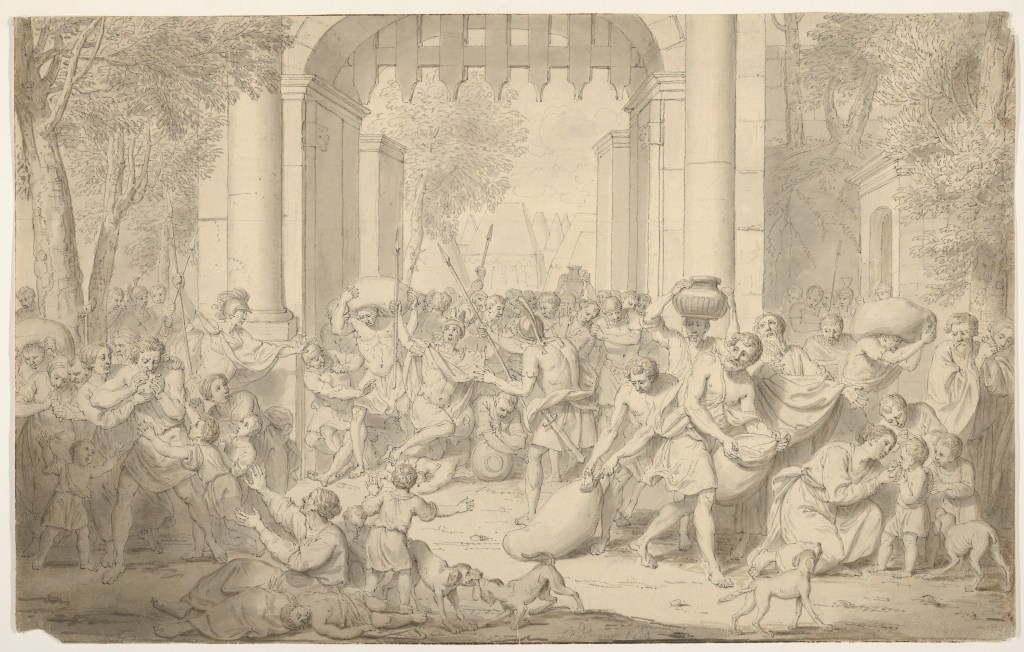
Before we get into the grubbier parts, let’s take a look at an incident during the Siege of Rome that Procopius did report in the History of the Gothic Wars. You may or may not remember a commander named Constantinus, who had held Hadrian’s Mausoleum during the Goths’ great assault. Military talent does not exclude the possibility of personal failings, of course, and it seems Constantinus was a light fingered rogue. According to the story related by Procopius, a wealthy Roman named Presidius had in some way angered Vitiges, and fled Ravenna to seek Belisarius’ protection. This was at about the time Vitiges was preparing to march on Rome. He brought none of his belongings with him, except a pair of daggers with very fine scabbards, worked in gold and ornamented with precious stones. Presidius arrived at Spoleto at about the same time Constantinus did with his expeditionary force. Hearing about the daggers, Constantius sent an aide to relieve Presidius of his treasures. No justification for this blatant bit of pilferage is ever offered.
While the siege was ongoing, Presidius felt he had no recourse, but when the pressure began to ease, he began to pester Belisarius with letters. Belisarius repeatedly reproached Constantinus, but the junior officer always evaded the question, and worse, taunted his victim in public. Finally, Presidius lost patience, intercepted Constantinus in the forum and grabbed his bridle. “Does the emperor’s law require that men fleeing barbarians be robbed of what they have left?” He made such a scene and, and refused to let go or be moved unless Belisarius agreed to see him in person. Belisarius so agreed, and he, Constantinus, and a number of other commanders met Presidius in the imperial palace. Even in the face of his accuser and his general and peers, Constantinus refused to surrender the daggers, saying he would rather throw them in Tiber than give them up. Belisarius lost his temper.
“Are you under the impression that you are not subject to my orders?”
“Of course, all other orders but this one, which I will never obey.”
Belisarius called for his guards to enter.
“You mean them to kill me,” Constantinus said.
“Of course not,” replied Belisarius, “But they will compel you to return those daggers.”
But Constantinus was beyond reason. Convinced he was about to be murdered, he drew his own dagger and lunged at Belisarius, who only just managed to dodge the attack. Constantinus started to pursue, but was seized by two of his fellow commanders. He was dragged off, and some time later was quietly executed. Procopius doesn’t say so, but I assume that Presidius got his daggers back.
What to make of all this? First I assume there is some information missing from Procopius’ report of the situation. It’s hard to imagine a reason these things would be worth so much to Constaninus, unless there had been some earlier slight to his honor that he felt would be recapitulated if he caved to Presidius’ demand. Even so, I think it’s pretty obvious that there is also a management issue here. Constantinus was a competent commander and soldier. Obviously that doesn’t exempt him from bad personal behavior or poor judgment in other areas. But the fact that he ignored his commanding officer for months, and worse, knew he could ignore his commanding officer for months, is a pretty strong indicator that something was wrong.
I haven’t made a big deal of it, but along the way Procopius has related several incidents of rebellion, insubordination, and treason along the way, and in almost every case the malefactors were punished by impaling. Yet Constantinus seemed confident that he could get away with this petty crime. Maybe it’s the small-potatoes nature of the offense that made Constantinus so confident, and maybe that’s part of the problem. If an army consistently sees that their commanders are above the law, then their respect for the law will erode, along with their respect for their commander-in-chief, theoretically the representative of that law. But that’s a very sophisticated explanation, and it’s not as if legal double-standards were anything new, in any society. Procopius, in the Secret History, offers a much simpler, more visceral explanation for Belisarius’ discipline problems; his wife.
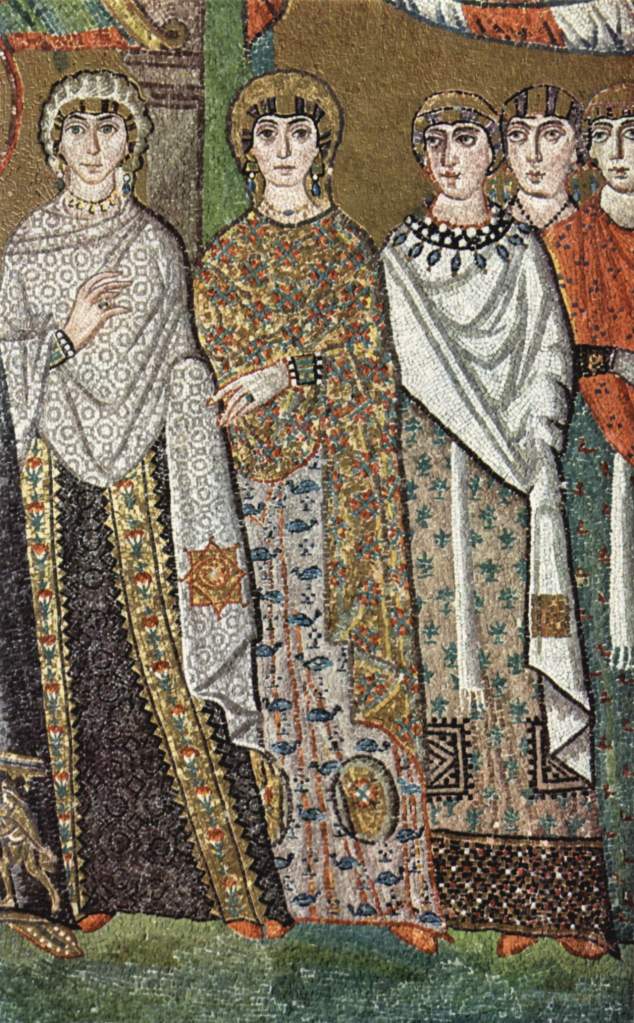
By Meister von San Vitale in Ravenna – The Yorck Project (2002) 10.000 Meisterwerke der Malerei (DVD-ROM), distributed by DIRECTMEDIA Publishing GmbH. ISBN: 3936122202., Public Domain, https://commons.wikimedia.org/w/index.php?curid=155438
It was not at all uncommon for officers’ wives to accompany their husbands on campaigns, as was the case of Belisarius’ wife Antonina. She appears in the Wars a few times, usually in a positive light. She convinces the general to rest and finally take some food at the end of the first day of fighting during the siege, and Procopius gives credit with helping him arrange shipments of supplies from Naples to Rome. The Antonina that appears in the Secret History, though, is a very different creature.
According to Procopius, and again, we have to be careful of this entire document, Antonina’s background was similar to Theodora’s. A child of the circus, she had been a courtesan and generally the kind of girl you don’t take home to mother. Procopius doesn’t say how she came to be married to Belisarius, but does note that she had already had several children by the time they were married, and that once married, Antonina controlled her husband with wiles and enchantments. Theodora at first took against this new lady of the court, perhaps as an unpleasant reminder of her own past, but once Antonina had proved a skilled and willing accomplice in the empress’ intrigues, the two became friends.
Just before leaving for the African campaign, Belisarius adopted a young man named Theodosius, who accompanied him. Antonina began an affair with Theodosius, at first in secret, though her discretion waned over time. Belisarius caught the two together in Carthage, though Antonina was able to talk her way out of it, and Belisarius was willing to be deceived, if you see what I mean. Later in Sicily, a servant woman spilled the whole beans in terms that the general could not ignore, and Theodosius was forced to flee for his life. Antonina escaped serious consequences again, for Belisarius was too much in love with her to take harsh action. There was much grumbling among the general staff about the incident, with Constantinus specifically saying that it would have been better to kill the wife rather than the lover. Antonina held a grudge against Constantinus after that, and it was she who talked Belisarius into executing him over the affair of the daggers.
Once again, I have to stress the unreliable nature of the Anecdota. There is simply no way to tell how much is true and how much is fabricated. Since Procopius presumably wrote it for an audience mainly consisting of his friends at court, who would have been privy to the same gossip he was, it’s possible that the thing was intended to satirize both the court and the gossip itself … which is a take I don’t remember seeing anywhere before. Hm.
All of that having been said, if Belisarius was routinely being cuckolded by his wife, and it was public knowledge, it wouldn’t be surprising if he struggled to keep the respect of the men under his command. The Romans in general were not particularly tolerant of feminine infidelity, and the introduction of Christianity had further clamped down on sexual mores. Attitudes toward a man seen as unable to control his woman would be pretty unforgiving.
Antonina continued to scheme and philander through Belisarius’ later campaigns, to the extent of plotting against her own son if Procopius is to be believed. Eventually, Theodosius took holy orders to avoid all the drama, which if all was as advertised, was probably a sound decision.
Criticism of Belisarius grew steadily in Procopius’ work, and rivals at court began to make an appearance in the story as well. If the general were already weakened by perceptions of his personal life, it may go a long way to explain why, as we will see going forward, so many of his orders were to be ignored, countermanded, or co-opted by subordinates and rivals. Which should give you an idea of what will be forthcoming in later episodes.
Now, let us move on to the question of whether or not all of this was going on against the background of the worst year in all of human history. That is all the effort I am willing to expend on this segue.
In 2018 Michael McCormick, professor of medieval history at Harvard University, nominated 536 as the worst year to have been alive. The blurb found a little bit of traction in 2020 as the Covid Pandemic wore on, and people began to talk about 2020 being the “worst year” of all time. No matter what the subject, someone on the internet is waiting to push up their glasses, raise a finger, and say, “ackshyully”.
Leaving 2020 behind us – as we all were very happy to do of course – let’s talk about Dr. McCormick’s quip, and his reasons for declaring 536 to be the nadir of human experience. I’ve had more than one person email me or leave a comment wondering whether I was planning on addressing the idea, and since the narrative has arrived in the ballpark of 536, I figured it would be a good idea to mention it before the moment passed.
The main thing you’ll find when you google “536 worst year” is an article from Science magazine describing research on a Swiss glacier. Ash found in ice cores indicates a large volcanic eruption in the first half of the sixth century. These kinds of samples are a relatively new tool for historians and archaeologists in studying the climate and environments of the past. The Science article, at least online, has no citations, and in spite of some diligent hunting, I wasn’t able to find the exact context for Dr McCormick’s quote, though I was able to find a few of the papers generated by the ice core research. The upshot is that a huge amount of volcanic material was thrown into the atmosphere, casting a pall over much of Europe and significantly affecting the weather, with catastrophic results on agriculture.
Enough about that: is it true?
Well, let’s turn to the historical sources.
Our familiar friend and guide made this note in his history of the Gothic Wars: “For the sun gave forth its light without brightness, like the moon, during this whole year, and it seemed exceedingly like the sun in eclipse, for the beams it shed were not clear nor such as it is accustomed to shed. And from the time when this happened men were free neither from war nor pestilence or any other thing leading to death.” He places these events in the tenth year of Justinian’s reign, aka 536.
Further afield, the monk keeping the Annals of Ulster noted in 536, “A failure of bread.”
The Annals of Tigernach noted in 538 “A failure of bread.”
And whoever was keeping the Chronicon Scotorum noted in 541, “A great mortality, which is called Belefeth.”
Back to an old friend. In a personal letter written in 536 or 537, Cassiodorus wrote, “Since the world is not governed by chance, but by a Divine Ruler who does not change His purposes at random, men are alarmed … at the extraordinary signs in the heavens … The Sun, first of stars, seems to have lost his wonted light, and appears of a bluish color. We marvel to see no shadows of our bodies at noon, to feel the mighty vigor of his heat wasted into feebleness … Strange has been the course of the year thus far. We have had a winter without storms, a spring without mildness, and a summer without heat. Whence can we look for harvest, since the months which should have been maturing the corn have been chilled…? How can the blade open if rain … is denied to it? … The seasons seem to be all jumbled up together, and the fruits … cannot be looked for from the parched earth.”
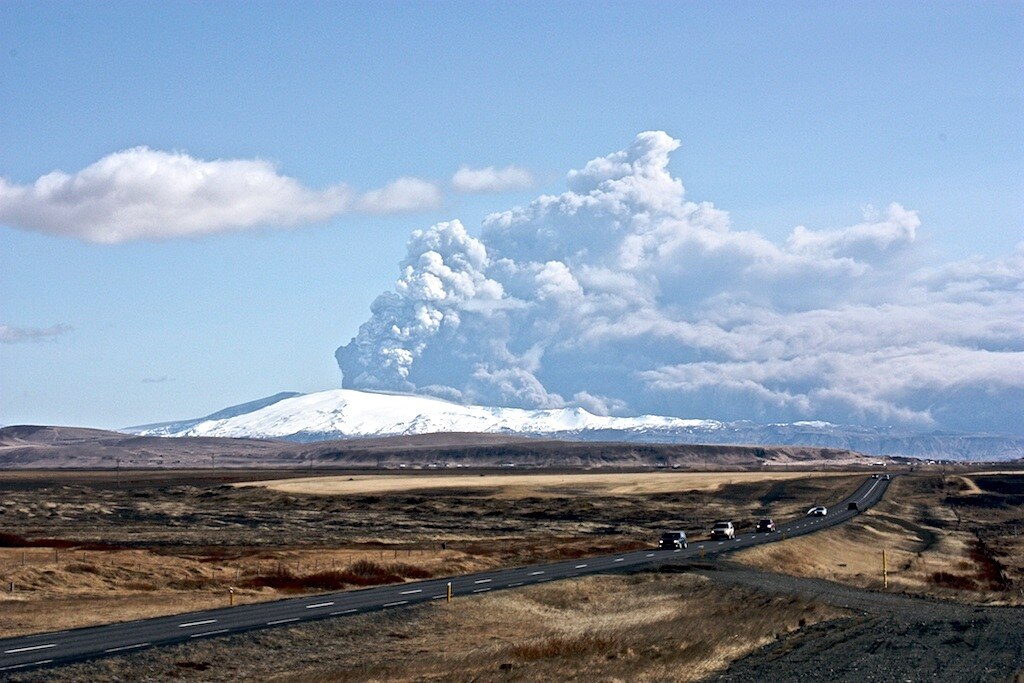
A dimming of the light of the sun, which lasted many months at least, and made the summer cooler than it should have been. Certainly sounds like it matches up with the evidence from the glacier cores, so I think, yes, that Icelandic volcano seems the perfect hook on which to hang the mysterious darkness. Many of us remember the fun we had in 2010 trying to pronounce Eyjafjallajökull, and so also remember the havoc that a single well placed Icelandic eruption can wreak on an unprepared Europe. That eruption was relatively small, and had no appreciable effect on global weather patterns, but we don’t have to look far for volcanic events that have. I for one am old enough to remember the spectacular sunsets that resulted from the eruption of Mt. Pinatubo in 1991. More substantially, that eruption lowered the global average temperature by more than half a degree celsius, for a while reduced the amount of sunlight reaching the earth’s surface by 10%, and the ash cloud remained in the upper atmosphere for three years following the eruption.

Image by CSIRO https://creativecommons.org/licenses/by/3.0/deed.en
Combine the location of Eyjafjallajokull and the intensity of Pinatubo, and it can be pretty well concluded, I think, that an Icelanding volcano was responsible for the darkness that fell over Europe, and indeed the world, in the second half of the 530s. That darkness and cooling had a devastating effect on crop yields, and famine inevitably followed. Malnutrition weakens the body and makes it more vulnerable to disease, so pestilence is almost always hard on the heels of dearth. And the movement of large groups of people seeking relief from such hardships can often bring war, even above and beyond the already endemic violence we’ve become familiar with on this show. There’s a reason that the horsemen of Revelation are usually identified as famine, pestilence, and war, the three are intimately related, with death following all.
What about the worst year tag? Well, these things are always going to be subjective. It’s also kind of presented in a “other people have had it worse so stop whining” kind of way, which has never seemed a particularly strong argument to me. 536 certainly wasn’t a great year, and things were tough everywhere, but the real lurking darkness wouldn’t arrive on our European stage until a handful of years later.
There is a theory, and it is only a theory, that the cooler weather somehow triggered an environmental change leading a certain bacterium, or maybe its vector, the flea, to change its behavior, become more virulent, and begin to spread. Maybe it happened in central Asia, which is where the genetics research points, maybe it happened in sub-Saharan Africa, which is where the geography points. Either way, five years after the darkness fell on the land, a ship arrived at Pelusium in Egypt, carrying sailors who complained of painful swellings in their necks, armpits, and groins, which turned black and gangrenous before the afflicted died in terror and agony. It was the first recorded appearance of the bubonic plague, and it will get its own episode in its own time. I mention it to make the point that maybe 536 is just a little bit too early to be calling “worst year in human history”.
All of this kind of talk though – 541 was worse than 536 – is hair splitting and a little bit silly. I am willing to concede that the 530s and 540s were not good decades for most of the world, but so what? Are we building a time machine and making a list of places to avoid? That’s going to be a really long list, regardless of whether any one entry is the worst entry.
For just about everyone listening to this podcast, and certainly for the guy producing it, being transported to just about any time and place in the show’s remit would be devastatingly traumatic, and probably very quickly fatal. This is where the unproductive ranting started in my first draft, so here is where I shall break off. We will be back to the regular stuff in coming episodes, and in the meantime look for a bonus episode which should have dropped at roughly the same time this one did. It’s a departure for us, but I hope you’ll find it interesting.


Leave a comment