
c.450-600
When Clovis, king of the Franks, died in 511, he passed on to his sons a huge territory, containing many millions of people. In this episode, we take a look at those people, how they made their livings, and how they organized society around them.
Hello and welcome to the Dark Ages Podcast. This is episode 55: The Kingdoms of Francia.
Last time, we finished with a call for votes for our next subject, choosing between the Franks and the Ostrogoths. Thank you to all of you who participated across all the various platforms. It was a very tight race, but in the end the winner, by just seven votes, was the Franks, and so here we are. Italy will have to wait its turn.
I’ve built up the Franks and their ruling Merovingian dynasty for quite some time, and really hammered the complexity of the story. There will be a lot of names, a lot of them very similar, and the potential for weeds and getting deep into them is strong. To add to my narrative issues, the last time we talked about Franks in any kind of depth was episode 37. Thanks to my various scheduling gaps and general fecklessness, if you’re listening in real time, that means that it’s been over a year and a half. Sorry.
That being the case, I think it behooves me to take an episode to set the scene and remind us all what it is we’re doing here. How often do you get to use the word behooves? I like it. That’s what this episode is going to be, the behoov-ed scene-setting. We’ll talk a little bit about the geography of the Frankish realms, not too much since having someone describe a map isn’t great audio. The core of the episode will be some talk about the economy and society around Clovis at the time of his death. There will be talk of marriage, aristocracy, economics, society, and trade.
This episode got away from me a bit.
I had intended to introduce Clovis’ sons at the end, but in the end it just would have been too long, so I’ll save that for next time. It probably makes more sense that way anyway.
I would ask if that all sounds okay, but it’s a podcast, and all of your feedback is necessarily after the fact, so let’s just get on with it.
Geography
The Frankish realms at the time of Clovis’ death in November 511 comprised most of modern France and Belgium, as well as most of modern German states of Baden-Württemberg, and the Rhine Palatinate, though the eastern extents of his conquest are a little harder to nail down than the others. That meant that there were significant amounts of territory and populations incorporated into the Frankish realm that had never been under direct Roman rule, and those areas, as we’ll see, would develop differently.

Clovis’ hegemony over the former provinces of Gaul was not complete though. In the south, the Visigoths still clung on to Septimania, that strip of coast between the Pyrenees and the Rhône and as far inland as Carcassonne. Right next door, Provence was ruled directly by Theodoric the Great, who was also at the time acting as regent of the Visigothic kingdom. The Burgundian Kingdom remained independent in the southeast, straddling the Rhône and controlling it from Geneva to as far down as Avignon. We’ve talked about all of that before. Lastly, in the far west, Brittany was isolated by dense forests and remained independent in practice. It was at this very moment, in fact, being settled by refugees from the Germanic invasions of Britain, giving it a Celtic character distinct from the rest of France.
The sharper among you may have read between the lines and guessed that this list of territories not ruled by the Franks may be by way of foreshadowing… and if you did guess that, you’d be right. But we’ll save that process of war, deceit, and occasional statesmanship carried out by Clovis’ successors for the coming episodes. In this one, let’s see if we can build a picture of the lands, and more importantly the people that Clovis ruled and how they made their livings.
Population
To start with, population. Any attempt to come up with a hard number for the population of Gaul is to be treated with extreme caution and ringed around with weasel words like “perhaps”, “roughly”, and “guess”. But that being said, a reasonable number seems to be between six or seven million. Of that six or seven million, at the time of Clovis’ death, probably 150 to 200,000 would have identified themselves as Franks. Those numbers are, to be honest, probably generous, but the proportions are probably about right. So that’s about 2-3% of the population that lives, eats, and speaks Frankish, everyone else is a Gallo-Roman who speaks Gallo-Romance; the idea that the Germanic migrations represented a wholesale replacement of populations has been at this point definitively sliced into the long grass.
The extent of Clovis’ conquest meant that the Frankish kingdom was much bigger than the Frankish homeland. Most of that 2-3% were concentrated north of the Loire, with the core region being between the Seine and the Ardennes forest. In that region, the cultural influence of this minority was enormous and out of all proportion to its size. Within a few generations, Frankish names become much more common than Latin ones, and no chronicler refers to those north of the Loire as romani anymore. All that remained of the old identification was language – they were now Franks who spoke Romance. I really should do an episode on language, at some point. In the core Frankish areas Frankish continued to be spoken into the seventh century, but the day to day language of most was the one based on late, vernacular Latin.
Further south the lands were ruled by Frankish lords, but Roman traditions carried on much more strongly. There’s little evidence of migration after Clovis’ victory at Vouille; Frankish lords were likely sent to administer the new provinces, but no attempt was made to settle the region with Frankish farmers. Thus the people south of the Loire continue to be referred to as Romani, and the language and customs of the south carried on with much less Frankish influence, and the cultural divide between Northern and Southern France began to open up..
Society
Lavoye
But let’s let all that big picture stuff go and take a look at the society that Clovis and his sons ruled over. We’ll focus on the north, where the Frankish way of doing things has come to predominate.
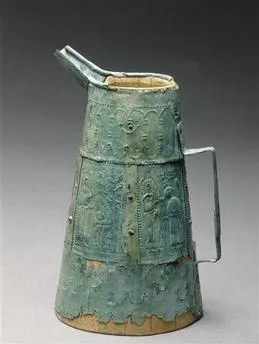
As a starting place, let me take you to a place called Lavoye, in the Meuse Valley, about halfway between Paris and Metz. Today, Lavoye boasts a population of 145, and you could probably call it sleepy without much argument. It has a coat of arms, like most communes in France, and this one has an odd feature. On the right stands what looks like a straight-sided pitcher, something that looks like it might contain some sweet tea or lemonade. On the left, much less unusually, is a sword. Both are references to an archeological find made here in the early 1900s, though it wasn’t fully published until the 1970s.

CC BY-SA 4.0 https://creativecommons.org/licenses/by-sa/4.0, via Wikimedia Commons
The village had been the site of a Gallo-Roman villa, but that’s not the interesting part, the interesting part is the cemetery that was established at the site. It contains 362 graves, arranged in rows and oriented north to south. Of those 362, 192 can be dated from around 500 to maybe 675, after which grave goods disappeared, making dating much more difficult. At the center was the oldest, deepest, and largest tomb, containing maybe the local chief, and his treasure.
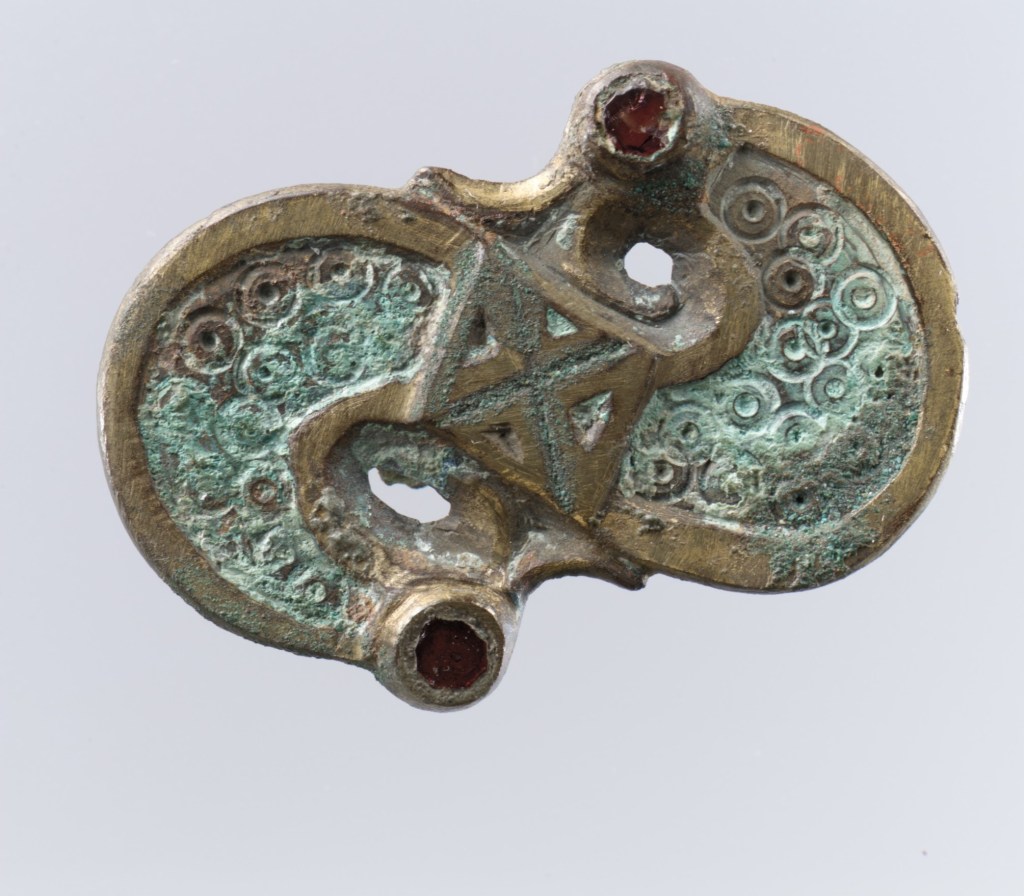
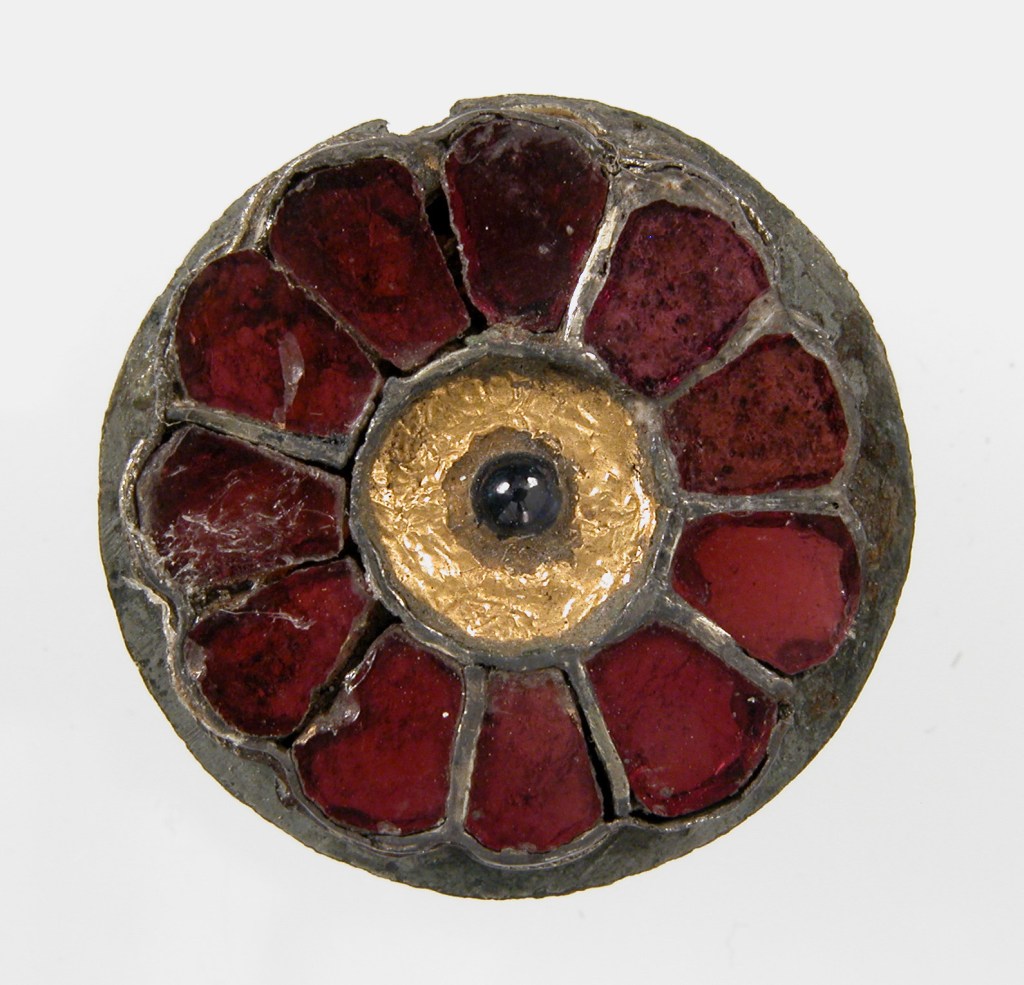
Compared to the glorious find at, say, Sutton Hoo, or the tomb of Childeric, the Lavoye treasure in tomb 319, is a little less impressive, but those were royal burials. Here we have the burial of a local chief, a strongman probably connected in some way to the Frankish Royal house, but whose horizons were quite a bit narrower. Compared to his neighbors and servants, his possessions were of amazing beauty and value. A sword, almost a meter long and decorated in gold, silver, and garnet. A belt buckle and a purse with a clasp clasp likewise ornamented with gold cloisonne and garnet. Javelin heads. A shield. At his feet, a glass bowl of fine workmanship and a pitcher covered in bronze and decorated with scenes from the life of Christ. The pitcher was used in the mass, possibly to hold the wine for the eucharist, and most likely had been pillaged from the church for which it was originally made.
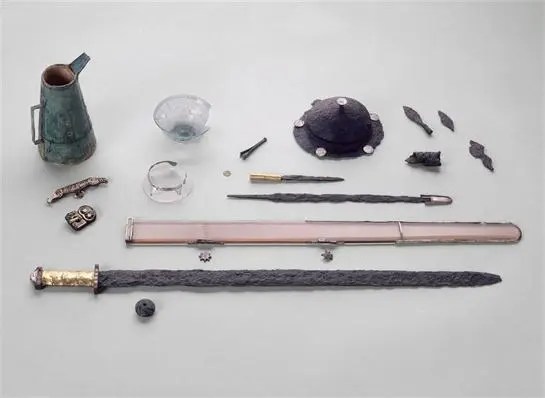
Similar objects are found widely across northern France and into Germany, on both sides of the old Roman frontiers. The man to whom these belonged was both a man of wealth and a man of war, and also a man with a place in a wide cultural zone. The tombs nearest the chieftain’s are also large, three of them occupied by women, with equally fine jewels, vessels, and distaff weights. Spreading out to the north, east, and west of this grand tomb, the graves of the rest of the community yield similar items, but much less grand, ornament completely absent from many of them. This community will be our framework as we try to understand Frankish society.
Marriage
The basic unit of society was the household, though that term has much broader connotations than we might usually use it today. Beyond just parents and children, the household included everyone who was dependent on the householder, so included domestic servants, slaves, and relatives who might be taken in for educational or charitable reasons. The father was the head of the household, in a way that meshed very easily with Roman patriarchal norms. The father had authority over all of them, but also responsibility to see to their well-being. There’s no doubt that all of the people of the household “belonged” to the master in a way that may make us uncomfortable now, some having more rights than others, but it’s important not to be too presentist about that idea. It’s not necessarily an entirely negative thing. Everyone “belonged” to someone. Life was precarious, and someone who didn’t belong to a community of some kind would not survive for very long.
It’s entirely likely that all three of the women buried nearest the chief were his wives, and entirely possible that they were his wives all at the same time. Even after Clovis’ conversion to Christianity, the Franks practiced polygyny, much to the church’s distress. A man could have as many wives as he could afford to support – which realistically pretty much limited the practice to the upper rungs of society.
Marriage, as in many societies, incorporated an element of economics. Every member of a community had value to that community, and women were valued especially highly, mainly for their childbearing potential. The loss of any member of a community required compensation to that community. In the case of murder or accident, that compensation took the form of a weregeld – a fine levied in an attempt to avoid destructive blood-feuds from being established. In the case of marriage, where a valued woman was removed from one community to another, the compensation came in the form of a reverse-dowry, payment from the groom to the bride. Again, it’s easy with our modern eyes to condemn this kind of thing as the simple sale of women, but no one at the time would have agreed. In Frankish society, dowries were substantial, traditionally one-third of the groom’s property, again reflecting the high value women had. A second gift from husband to wife was expected after the marriage had taken place, called the morgengabe, and the father of the bride usually also pitched in a wedding gift for the couple.
That was for one kind of marriage. A second kind was also common, which was less formal and required no transfer of property. This was called a Friedelehe, and was a private agreement between a man and woman. It was not, in other words, organized or negotiated by heads of households, or formalized by a religious ceremony, and was therefore a threat to the authority both of the pater familias and the church. Often a pretext of abduction was used; the hopeful groom kidnapping his bride to be, with her consent and cooperation. Once the union was consummated, the brides family had three choices: seek vengeance through violence with all the risks that that entailed, pursue the groom through legal channels seeking compensation for the rape of a daughter, or accept the abductor as the woman’s husband. Most often, the latter was the result. Such marriages were publicly recognized, though not always approved of. Let us not pretend that this kind of thing always had the woman’s consent, though, I have no doubt that there were plenty that involved coercion and maybe violence, but we should not be misled by that word abduction to believe that they all did.
Concubinage was also common, between marriages or alongside them, all the way into the eighth century. The church often objected, and gradually managed to chip away at the acceptance of such a varied array of arrangements.
All children could potentially inherit, including illegitimate ones, though they were at a disadvantage in disputes. The Salic law promulgated by Clovis famously bars women from inheriting “Salic Land”, but no one actually knows for sure exactly what that means. It seems clear that women were barred from some real property inheritance, but could definitely expect a share of moveable wealth when her father or husband passed away. A wife could easily inherit all of her husband’s property upon his death, and be absolutely free to control it without reference to male authority.
Lordship
Being a householder, absent any other rank or title, was an elite status in itself, establishing a household required resources, and those resources were based on land. Kings, magnates, even the more prosperous peasants, were householders, and distinctly in the minority. The majority of people lived as parts of other households, as hired hands, house-slaves, the children of neighbors, and unmarried relatives. Everyone would have had a job of some kind, to contribute to the household’s prosperity, and in turn the householder would ensure they were fed, clothed, and safe. As you can imagine, the size of any given household depended on the wherewithal of the householder, and could range from the nuclear family only to the dozens of servants and armed bodyguards, and other hangers-on of the king and other great men.
The basic worldviews of the Frankish and Gallo-Roman aristocrat were pretty well aligned, which no doubt smoothed the merger of the two. The power of both was based on landholding. Those lands were originally distributed according to rank, but were heritable, meaning that the Frankish aristocracy did not depend on the king for their wealth or position. The landowning class existed prior to, and developed alongside, the Merovingian kings. They expected to play a role in the government of the kingdom as well. Most of the functional offices of the king – the counts and dukes – were filled by these rich men. Their status gave them influence, not the other way around.
Titles
A quick aside about titles, by the way. Today, the term count, duke, or earl all refer to levels of aristocracy. That was not the case in the Merovingian kingdom. For the merovingians, they were job titles. Count comes from the Latin comes, companion, and implied a position within the ruler’s household. Roman comes had specific jobs and responsibilities, a system that was retained by the Visigoths and Ostroogoths. In the Merovingian Franksih system, comes indicated only a connection to the king and a broad responsibility and mandate to execute his wishes. The exceptions were the absolute highest positions, for example the comes palatii – in charge of the whole royal household, or the comes stabuli – in charge of the stables and mounted fighters, and from which the world constable derives. Comes would also sometimes be tasked with the governance of a region, and given the slowness of communication, these men would perforce have a pretty wide latitude in their affairs. Gregory of Tours refers often to these propertied men, using their influence and position to enrich themselves by both legal and illegal means. Dux meanwhile is a military title which in Roman times indicated authority over an entire province, which was carried on by the Franks. A dux was of higher rank than a comes, but as you may have already guessed, the finely graded hierarchies of the late middle ages have not yet developed.
If you have any background in medieval history, then you know that for a long time kings were dependent on churchmen to fill the ranks of their bureaucracy, since clerics were pretty much the only literate people. That was not yet the case in the Merovingian kingdoms. Most territorial administrators and close household men of the king’s were lay nobility, and literacy among them must have been relatively high. The government of the Merovingians would have generated a sizable corpus of correspondence, but none of it has survived, because it was mainly conducted on papyrus, not the more expensive and more durable parchment. The frustrations of the historian.
The Aristocratic Mystique
The aristocracy had a second source of power, aside from simple wealth and relationship with the king. An essential and intangible kind of charisma, derived from a history of success, leadership, and fame. It clung to particular families who had a history and reputation for producing successful fighting men. But this quality had to be continuously demonstrated and maintained. An aristocrat was expected to uphold his status through his lifestyle. Building a shared worldview in solidarity with his neighbors, by hunting together, fighting together, and feasting together, served to protect a Frankish aristocrat both physically and in reputation. The chieftain at Lavoye did not build fortifications to hide behind, as his Roman predecessor might have, instead he depended on his local relationships and the loyalty of his household and followers.
That loyalty was guaranteed and built by generosity. I’ve talked before plenty about the importance of largesse to a leader’s reputation, and usually that’s been in reference to the other fighting men that followed him, but it extended beyond that, both vertically and horizontally. Horizontally, nobles exchanged gifts with each other in demonstrations of affluence and generosity that I’m assuming involved no small amount of competition. Vertically, the great man was expected to distribute the fruits of his plunder both through direct gift giving and through communal feasting, where the local farmers and other free men and their families were received as guests and the beneficiaries of their chief’s hospitality. By so accepting, they placed themselves in his debt, and were thus obligated to come to his assistance when called to do so. This isn’t feudalism, these farmers and free men held their land by their own right, not from the lord in exchange for service. It is instead a much more subtle and complex system of lordship and mutual obligation that repeated itself up and down the social ladder, from the kings on down.
The Commons
The Free
So what about those others, the others buried around the chieftain of Lavoye? The graves are clustered in groups, suggesting kinship connections, another thread of loyalty binding society together. These freemen were the majority of the Frankish population and formed the backbone of both society and military. Exactly what we mean when we say “free man” is a little bit difficult to tease out. Freedom is relative, and deeply contextual, and certainly does not mean that such people were not dependent on their lords. Dependence is a given. It is the nature of that dependence that is the real question. The men of Lavoye were obligated to fight for him, and as fighters they then had the right to participate in public justice. The line between free and unfree was marked with a sword, or more likely a spearpoint. It was their status of fighting men that made them and their ancestors free. They may not own the land they worked, but they were free and legally belonged to themselves and the king alone.

Local lords of course placed pressure on these people, with generosity, threats, and the manipulation of local circumstances. Gradually more and more may lose whatever land they owned, as a bad year forced them to seek help from their lord, who would insist on concessions in return for assistance. Thus dependency might increase, but still the right to bear arms, and the right to participate in local courts and the exercise of justice, is what made free men and families.
The Unfree
Then there were all the rest; the unfree. The new blended Frankish and Gallo Roman society commingled several kinds of unfree persons, which came in various flavors. From Roman tradition came the coloni, the farmers who worked basically as sharecroppers. They paid a portion of their harvest to the landowner as rent on the land they worked. The colonate system had been reformed by Diocletian, tying the coloni to the land they worked and significantly degrading their position, and the trend had been downward ever since. There had already been a parallel tradition of allowing slaves to work land for their own support, and the distinction between coloni and these slave tenant farmers became increasingly academic. Most of the workforce of the Roman villas, especially in northern Gaul, were coloni.
Slavery in the early middle ages was just as present and accepted as it had been in the classical world, with some differences. The Franks had no tradition of the mass slave economy of the Romans; Frankish slaves were usually either prisoners of war or had lost their freedom through the judicial system. In the northern parts of the frankish domains, then, large gangs of field slaves were rare. Slaves usually worked as household slaves, more domestic servants than brute labor force. In the south, where the Frankish portion of the population was much smaller, the Roman system persisted much longer, with villas being worked by slaves the norm, until landowners began to come around to the idea that it was cheaper to assign land to work for themselves than it was to feed large crowds of slaves, and gradually field slave, slave tenant, and coloni merged into medieval serf. At both ends of the social spectrum, Roman and Frankish society were merging and changing.
Villages and Migrations
For everyone, free or not, day to day life would have been hard. Agriculture in Northern Gaul had been organized around villas in Roman times, meaning an isolated estate that produced much of what it needed locally. In the third and fourth centuries, these isolated settlements became more and more vulnerable to attack, and so populations became more concentrated for defense. These villages were distinct from the villae not only in their relatively high population density, but by their impermanence. Stone buildings were rare aside from churches; what was the point of all the effort and expense of a stone foundation if the house was going to be burned down every other year? Lightly built timber thus became the norm.
Eastward, on the German side of the Rhine, things were also changing. Archeologists find a significant dropoff in the number of inhabited sites in late antiquity, and then a century or two later, an increase in population density in the early fifth century. Around trier, twenty new sites appeared between 450 and 525, for example, with 28 more appearing before 600. It was a similar story around Cologne. These cities were in the more romanized portions of Germania, while further north and east populations continued to decline into the eighth century.
Often villages appeared around local religious sites, sometimes an old pagan shrine, a church, or a hermitage. Cemeteries reinforced the connection between the present and the past, and established a sense of continuity. They were often centered on the gravesite of a founding figure, such as a saint, our chieftain of Lavoye, or something older. At Flonheim, pre-Christian tombs had a chapel built over them, forming the center of the life of the new religion. Rather than condemning or forgetting the pagan past, the community retroactively Christianized it, and carried on as they always had.
The Economy
Agriculture
The vast vast majority of the population spent most of their time on agriculture. The agricultural techniques of the Early Middle Ages were pretty much a continuation of the techniques of the later Roman Empire, which was not necessarily a good thing. A fall of productivity had been underway since the third century, and a backsliding of technology. Farm machinery of the kind described by Pliny the Elder had completely disappeared, water mills were common only along the Rhone and some other rivers, land was abandoned and allowed to return to nature. The snap thought is that all of this must have to do with all those violent barbarian invasions, but the trend was evident well before that. A more likely cause of the contraction of agriculture was labor shortages and a tax regime that discouraged marginal lands from being cultivated. By the time ze Germans arrived, the decline had been apparent for a century or more.
Tools and methods were probably actually more primitive than you’re already imagining. The plow that was used was the simple hard plow, which is essentially just a stick, which cut a furrow but did not turn the soil over. The plow would usually be run over the field twice, the second time at right angles to the first, in order to maximize coverage. It and most other tools were made of wood. Iron was rare and difficult for the average person to get hold of. Appeals were made to local saints to assist in finding lost iron tools, and their recovery often went on the list of local miracles. They were used sparingly, mainly to make wooden tools.
The decline in agricultural production cannot be blamed on the Franks or their various Germanic cousins, but other changes can be.

Wheat had been the dominant cereal crop across the empire, but began to give way to darker, more hardy grains that arrived with the barbarians. In the north, barley and sometimes rye took up more and more space in the fields. These were hardier in the increasingly chilly climate, and could be stored longer than wheat. They could also be made into beer, which was more food than intoxicant.
The Franks also brought with them an emphasis on cattle raising. Cattle had been the primary measure of wealth east of the Rhine since Tacitus’ time, and became more common in Gaul as the Franks’ influence spread. In Clovis’ time, it remained a key indicator of status, as evidenced by the prominence cattle are given in the law codes compared to other livestock.
One surprising area where agriculture actually expanded was in wine production. Viniculture and Romanitas went together like butter and toast, but the period after 450 saw the expansion of vineyards into more northerly areas. Key to this was probably the church. Wine was essential to the mass, of course, and also was the drink of the elite. Every acre given to the vineyard was an acre not used to grow subsistence crops, which suggests that the aristocracy was making more decisions about land use in their territories.
The whole system was very inflexible. There were few options for increasing the productivity of a field, and most villages managed just barely enough to keep themselves fed, with a small surplus in good years. Bad years could and often did result in famine, sometimes catastrophically. For 98% of the population, the potential for disaster waited just outside the doorway, with its friends desperation and death close at hand.
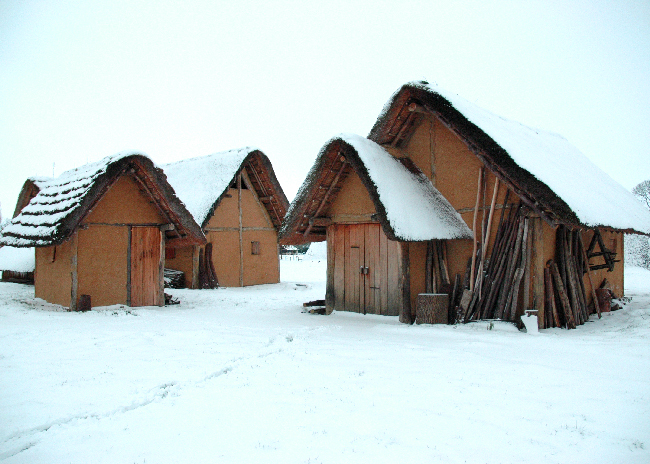
If you would like to get some kind of idea of what one of these villages looked like, by the way, in the show notes I’ve linked to some images from the Musée des Temps Barbares, in Marle, France, where they have built a reproduction of such a village. I know those links don’t work on spotify, so I will also make sure to put it up on instagram. The website is in French, but google is happy to translate it for you.
Towns and Trade
I’ve mentioned the decline of Roman urban life oh, about a million times now, and it is true that cities shrank significantly. Cities didn’t entirely disappear though. They were the homes of bishops, and to a lesser extent the regional comes of the Frankish government. Bishops and the ecclesiastical courts that surrounded them maintained social functions like poor relief, as well as organizing civic functions like the upkeep of walls, aqueducts, and so on. These had once been the purview of the secular elites, but as I have also mentioned over and over again, the rich had increasingly removed themselves from engagement in these kinds of civil projects. The comes or representatives of the king, also had a hand in city life, being more urban overall than the nobility would become in later centuries.
Both noble and churchmen collected the proceeds from their properties, concentrated them in cities and towns, and spent them. To service this elite trade, a far-flung mercantile network still existed. Its volume was reduced from imperial times, and merchants could no longer inveigle their way into official army transports as had once been the norm. But waterways were still open, the roads still largely passable, and long distance trade was still robust.
Of all the dark subjects in the dark ages, the most inky black to our historical eyes is surely the question of economics. Understanding the flow of goods and resources, and the mechanics of how trade was conducted, is deeply problematic for historians, and I don’t mean in an internet-debate kind of way, it’s just really really hard. As a result everything I’m about to say has been and will continue to be the subject of intense, table-thumping debate among historians. You have been warned, don’t bring it up at the tailgate unless you’re prepared to throw hands over it.
Most agricultural produce was consumed locally; any surpluses were distributed by sale, by gift, or by theft. Gift and theft seem to have accounted for more local trade than monetary sale. We’ve already talked about generosity and its role in cementing relationships. Friendships between householders were created and maintained through gift and counter gift, creating a web of mutual obligations that connected communities to one another. Bishops organized and maintained charitable distributions of excess food to the poor in their areas, thereby creating their own networks of dependents. Enemies likewise evened out local inequalities through raid and plunder, and kings took their share in the form of tribute, which they then in turn distributed to their own households. The vast majority of the economy of Merovingian Francia thus operated with hardly any hard currency being exchanged at all.
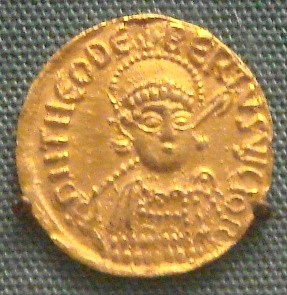
Coinage continued to be minted and to circulate, including gold coins, though the use of gold in Europe tapered off through the seventh century. There are historical references to merchants, customs and tariffs, and an import/export trade as well. So the international markets were not completely moribund. Indeed, the increasing prominence of the Merovingian monarchy and aristocracy may have driven an expansion of trade in the north. This trade was mainly carried out by Syrian, Greek, and Jewish merchants, who traversed all of Francia, sometimes by camel caravan, which is a striking idea. These merchants carried mainly luxury goods for elite markets; fine textiles like silk from the far east, garnets and other gemstones from India and Sri Lanka, and amber from the Baltic. These are the goods that gleam up at us from the mud of archeological sites and remind us that while much had changed since Roman times, there were still skilled artisans capable of producing extraordinary work for those who could afford it.
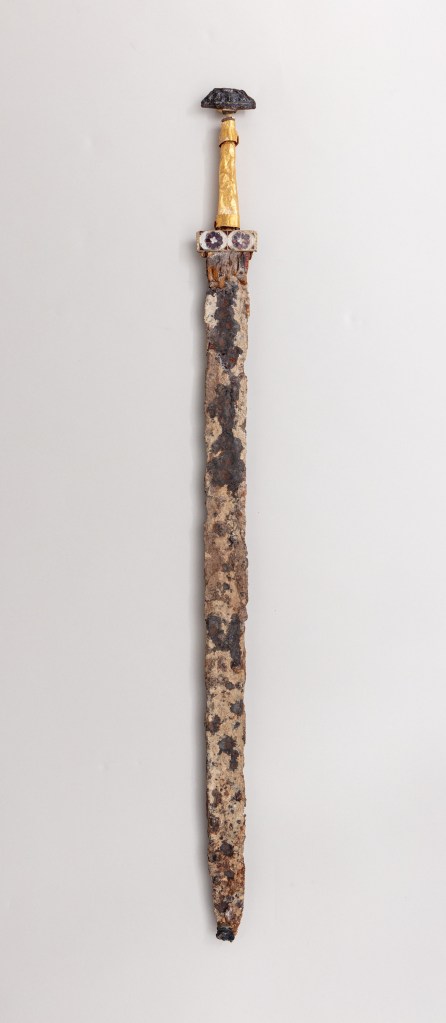
A third level of trade existed between these two, which was facilitated by towns and cities. Just about everything that was needed by a village was produced locally, but for some essential commodities that simply wasnt possible, so a more localized trade existed. Salt, for example, was produced by evaporation from shallow pans near the sea, and then shipped inland. Dried fish, wine, and oil were also part of this short-hop kind of trading. More specialized industrial production still existed in various places and their products were traded regionally. Glass from the Ardennes has been found in Sweden, pottery from the Mediterranean, in patterns that would have been recognized by Stilicho and Alaric, continued to circulate around Europe into the eighth century. The weapons produced in Merovingian Francia were highly valued, especially in Northern Europe, and were traded deep into Britain, Frisia, and Scandinavia. Indeed, many of the sword patterns so beloved of Viking enthusiasts are of Frankish origin, as are many of the swords themselves.
There is a story related by Gregory of Tours that demonstrates how these parallel economies coexisted and interacted. The new bishop of Verdun found the city to be impoverished, and wrote to king Theudebert (we’ll get to him, don’t worry about it) for a loan. The king sent 7,000 gold pieces, which the bishop distributed and thus reinvigorated the city’s commercial life. Gregory doesn’t give us any details on how he did that, since that’s not really the point. The point is, it worked, and worked well enough that the bishop was able to repay the loan, with interest. The king declined the repayment; much like Carmine Falcone, money was not as interesting to him as favors. It was far more advantageous to Theudebert to keep Verdun in his debt in the long term, than to have gold back. The cash economy fueled the merchant class, but it was the economy of obligation that motivated the aristocracy. Often, as in this case, it was the ecclesia that bridged the gap between the two.
Conclusion
When Clovis died, he was unchallenged as king of all the Franks, and of a lot of other people as well. Stretching across both Roman and non-Roman lands, his kingdom still enjoyed cultural and trade connections with the Mediterranean world, though it was quickly becoming its own, new beast. As elsewhere in the former empire, agricultural sophistication had been falling for some time, and the climate changes that would come along in the 530s would only exacerbate that trend. Church and state were closely linked, but not as intimate yet as they would become in the later Carolingian era. He was at the head of a caste of aristocrats who derived their own power only partially from their relationship to him, which would make for some difficult times later down the road.
Overall, the hierarchy of society was pretty flat, with the massive majority of people living and working perilously close to the edge of starvation and disaster at all times, and a minute minority controlling almost all of the wealth. But, as we’ve seen, there was still trade and a tradition of open-handedness from both aristocrats and church could help to mitigate the worst deprivations, though it often wasn’t enough to overcome the simple realities of an inefficient and inflexible agricultural system.


Leave a Reply